
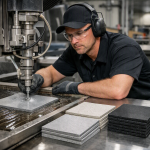
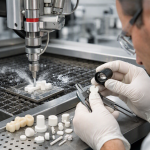
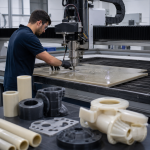
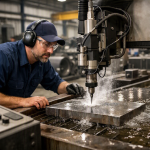


Rubber cutting services at Hydro-Lazer, Inc. in Freeport, Pennsylvania, use advanced waterjet technology to cut a wide range of rubber materials, including neoprene, silicone rubber, sponge rubber, nitrile, polyurethane, and polyacrylic, with clean edges, zero thermal distortion, no deformation, and no fumes. Capable of cutting rubber up to 240mm thick with no cutting dies or additional tooling required, Hydro-Lazer brings well-documented knowledge of rubber material characteristics to every production run.
Does Waterjet Cutting Work on Neoprene Rubber?
Neoprene is one of the most commonly specified rubber materials for industrial seals, gaskets, and weatherstripping. It is also a documented compatible material for waterjet cutting at Hydro-Lazer.
- Compatibility: Both neoprene rubber and neoprene are listed as compatible materials on Hydro-Lazer’s rubber cutting services page. It appears twice, reflecting how often this material arises in industrial applications.
- How It Works: Neoprene is a soft elastomer that responds poorly to heat. Conventional thermal cutting methods distort their edges and alter their sealing properties. Waterjet cutting runs cold, which eliminates both edge distortion and property changes at the source.
- What You Get: Parts arrive with burr-free cuts, clean edges, and fully preserved material form. No secondary finishing is needed before installation or assembly.
Can Waterjet Cut Silicone Rubber Without Affecting Its Properties?
Silicone rubber is a heat-resistant elastomer widely used in medical, food processing, and industrial sealing applications. Surface integrity and contamination control are especially important when choosing the cutting method for this material.
- Compatibility: Silicon rubber is a documented compatible material for Hydro-Lazer’s rubber cutting services.
- How It Works: Silicone’s thermal resistance is valuable in service. However, it offers no protection against surface contamination or edge degradation from cutting fumes or heat byproducts. Waterjet cutting runs cold and contact-free, preserving surface integrity and avoiding exposure to chemical byproducts entirely. This matters most for food-contact and medical-grade components.
- What You Get: Clean cuts with zero heat-affected zones, zero fumes, and zero thermal distortion. Silicone rubber maintains its material properties and surface condition throughout the cutting process.
What About Sponge Rubber: Can Waterjet Cut Compressible, Cellular Materials?
Sponge rubber presents a different challenge. Its compressible, cellular structure is prone to compression deformation under mechanical cutting pressure and to cell collapse under thermal stress.
- Compatibility: Sponge rubber is a documented compatible material for Hydro-Lazer’s rubber cutting services. Note: “Industrial-grade foam” as referenced in the article title is equivalent to sponge rubber, which is the documented material term used by Hydro-Lazer.
- How It Works: Waterjet cutting applies zero mechanical compression force to the material. The cellular structure of sponge rubber stays intact throughout the cut. Zero heat means cell integrity is fully preserved.
- What You Get: Burr-free cuts with edges that retain the material’s compressible characteristics. Parts arrive dimensionally accurate with no compression-induced dimensional change.
Does Waterjet Handle Nitrile Rubber for Automotive and Industrial Gasket Applications?
Nitrile rubber is the go-to material for oil-resistant seals and gaskets in automotive and industrial applications. Dimensional accuracy and edge consistency directly affect sealing performance for this material.
Compatibility: Nitrile is a documented compatible material for Hydro-Lazer’s rubber cutting services.
How It Works: Nitrile’s oil resistance comes from its molecular structure. Heat introduced during thermal cutting can alter surface properties and compromise resistance at the cut edge, precisely where sealing performance matters most. Waterjet preserves molecular integrity because it generates no heat.
What You Get: Precise cuts in desired shapes and dimensions, burr-free edges, and zero thermal distortion. Nitrile gasket components arrive with the dimensional accuracy required for sealing performance in automotive and industrial environments.
What About Polyurethane and Polyacrylic Rubber?
Polyurethane and polyacrylic are specialized elastomers with demanding performance requirements. Both are documented compatible materials for waterjet cutting at Hydro-Lazer.
Polyurethane
Used in abrasion-resistant industrial components, polyurethane is a documented compatible material. Waterjet cutting it without heat distortion preserves surface hardness and dimensional geometry throughout the cut.
Polyacrylic
A specialty elastomer used in high-temperature sealing applications, polyacrylic is also a documented compatible material. Waterjet’s cold process preserves the material’s thermal stability and prevents surface alteration from heat-affected zones.
What You Get for Both
Burr-free edges, accurate dimensions, and zero deformation. Both materials arrive ready for direct use in sealing and industrial component applications.
What is the maximum rubber thickness that a waterjet can cut?
Rubber component thickness requirements vary widely, from thin gasket sheet material to thick industrial blocks. The cutting method’s depth capability determines whether it can serve a full production range.
Hydro-Lazer’s rubber-cutting services handle rubber up to 240mm thick. The high-pressure water jet delivers precise shapes and dimensions across this full thickness range. Zero additional tools or cutting dies are required, regardless of thickness, so there is no setup overhead for thick-section rubber-cutting programs. Rapid programming and cutting speed reduce production time substantially compared to methods that require die fabrication before the first part can be cut.
Does Waterjet Rubber Cutting Require Any Special Facility Setup?
A practical consideration when evaluating a rubber cutting vendor is whether the cutting method creates facility compliance obligations, especially around fume generation and air handling.
Zero Fumes
Waterjet rubber cutting generates zero hazardous fumes. Facilities that use thermal cutting methods often incur ongoing costs for installing and maintaining air-handling equipment. Waterjet removes that compliance burden entirely.
Zero Cutting Dies
Zero die fabrication is required before cutting begins. Programs are set up through rapid digital programming so that new geometries can be introduced with zero retooling lead time or die replacement costs.
Zero Secondary Finishing
Burr-free output eliminates the need for post-cut deburring or edge-finishing stations. Parts move from cut to assembly or inspection with zero additional handling.
How To Get Started With Rubber Cutting Services at Hydro-Lazer
Getting a rubber cutting quote from Hydro-Lazer starts with a material specification and a design input. The process is straightforward for any rubber type, shape, or quantity.
Submit an RFQ at hydro-lazer.com/rfq/ or contact the team directly. Any documented compatible rubber material, any thickness up to 240mm, any shape and dimension. Zero cutting dies are required, which means zero tooling fabrication lead time before the first cut.
Hydro-Lazer Rubber Cutting Services in Freeport, Pennsylvania
Hydro-Lazer, Inc. 134 Armstrong Drive, Freeport, PA 16229 Phone: 724-295-9100 Email: john@hydro-lazer.com RFQ: hydro-lazer.com/rfq/
Compatible rubber materials: neoprene, silicone rubber, sponge rubber, nitrile, polyurethane, polyacrylic, nylon, acrylic, PVC. Maximum rubber thickness: up to 240 mm. Zero cutting dies required | Zero fumes | Burr-free output | Rapid programming
Frequently Asked Questions
Does waterjet cutting work on neoprene rubber?
Yes. Neoprene rubber is a documented compatible material for waterjet cutting at Hydro-Lazer. Waterjet introduces zero heat, eliminating edge distortion and changes in sealing properties. Parts arrive burr-free and ready for installation.
Can silicone rubber be cut with a waterjet without contaminating the surface?
Yes. Waterjet cutting is a cold, contact-free process that generates no fumes or heat byproducts. Silicon rubber retains its surface integrity and material properties after cutting, which is essential for medical, food processing, and industrial sealing applications.
How do you cut sponge rubber without deforming it?
Waterjet cutting applies no mechanical compression force and no heat to the material, so the sponge rubber’s cellular structure remains intact. Hydro-Lazer’s waterjet process produces dimensionally accurate sponge rubber parts with burr-free edges and fully preserved compressible characteristics.
What is the maximum thickness of rubber that a waterjet can cut?
Hydro-Lazer’s rubber-cutting services can cut rubber up to 240mm thick. Zero additional tools or cutting dies are required regardless of thickness, and rapid programming means thick-section programs can be set up with zero retooling lead time.
Does waterjet cutting change the properties of nitrile rubber?
Waterjet cutting generates zero heat, so nitrile rubber’s molecular structure and oil-resistant properties are fully preserved through the cutting process. This is a clear advantage over thermal cutting methods, which can compromise nitrile’s chemical resistance at the cut edge.
Do cutting dies need to be purchased for rubber waterjet cutting?
Zero cutting dies or additional tooling are required. New cutting programs are set up through rapid digital programming, which eliminates die fabrication costs and lead times for new parts and design changes.
Does waterjet rubber cutting generate fumes?
Waterjet cutting generates zero hazardous fumes. Facilities do not need to install air-handling equipment, unlike thermal cutting methods, which require ongoing fume management and lack infrastructure.
Can a waterjet cut both dense rubber and compressible sponge-type rubber?
Yes. Waterjet cutting handles dense elastomers such as neoprene, nitrile, silicone, polyurethane, and polyacrylic, as well as compressible cellular materials such as sponge rubber. The contact-free process preserves structural integrity across both material types.
What rubber cutting services are available near Pennsylvania?
Hydro-Lazer, Inc. in Freeport, PA, provides rubber cutting services for a wide range of rubber materials, including neoprene, silicone rubber, nitrile, sponge rubber, polyurethane, and polyacrylic. The facility serves manufacturing, sealing, gasket fabrication, and industrial production customers and can be reached at 724-295-9100 or hydro-lazer.com/rfq/.
Is waterjet rubber cutting suitable for gasket fabrication?
Yes. Waterjet cutting delivers the dimensional accuracy and burr-free edge quality that gasket fabrication requires. Compatible materials include nitrile, neoprene, silicone rubber, polyurethane, and polyacrylic at thicknesses up to 240mm.