
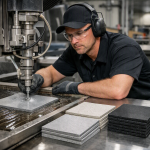
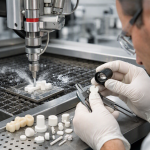
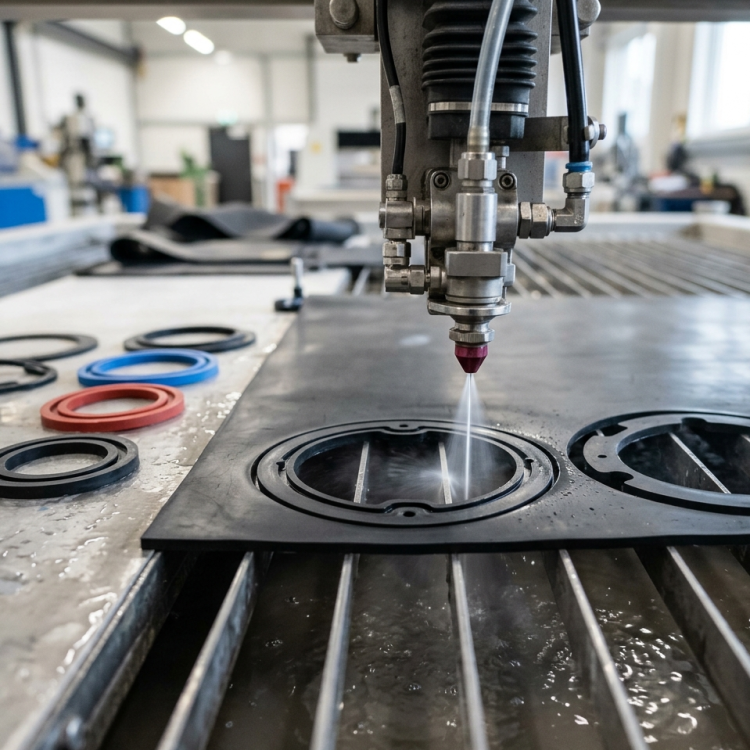

Rubber cutting services at Hydro-Lazer, Inc., located in Freeport, Pennsylvania, support the precise shaping of rubber components across multiple industrial applications. The process uses waterjet technology that supports stable material integrity during shaping. A thermal free approach supports smooth edges and consistent geometry. Each component is shaped with controlled accuracy for reliable application use.
High-pressure waterjet flow supports refined cutting across various rubber types. Surface quality remains consistent across detailed part designs. Production workflows benefit from repeatable precision and steady output. Industrial applications gain dependable component performance through this method.
How Heat and Mechanical Contact Affect Rubber During Cutting
Conventional cutting methods on rubber are shaped by thermal interaction between cutting tools and elastomeric materials during processing. Heat transfer at the cutting point helps soften the rubber surface during shaping.
Slow heat dissipation leads to localized edge variations across the material structure. Dimensional change appears across processed areas under sustained thermal exposure. Mechanical pressure contributes to material flex during cutting movement.
Curved profiles and tight interior shapes influence material response during shaping processes. Flexible rubber behavior supports edge shift under compressive and shear force application. Material movement around the cutter path supports binding conditions during processing. Surface alignment varies as the tool passes through regions of elastic resistance in the substrate.
Thermal breakdown during cutting can support fume formation in processing environments. Air handling systems support controlled circulation in production environments. Waterjet processing supports cleaner edge formation with reduced thermal influence. Process stability is supported through controlled material separation during cutting operations.
Waterjet Rubber Cutting and How a Cold Process Preserves Material Integrity
Waterjet cutting is performed entirely by a high-pressure water stream. There is no heat generated and no mechanical contact between a cutting tool and the rubber surface.
No Heat at the Cut Point
Waterjet cutting is a cold process. Thermal stress on rubber is eliminated, preserving the material’s form and structural properties through the full depth of the cut. There is no edge softening and no thermal degradation of the rubber compound.
No Cutter-To-Material Contact
Because no blade, wheel, or die contacts the rubber surface, the binding failure mode is eliminated by design. The waterjet stream exerts no compressive or shear forces on the surrounding material. Only the narrow kerf path is affected, and the rest of the workpiece remains geometrically stable throughout the cut.
Burr-Free Edges With Little Material Wastage
Waterjet rubber-cutting services produce clean, dimensionally accurate edges on rubber without post-processing. The cut path is narrow, which preserves usable rubber sheet area and reduces per-unit material cost on production runs.
No Hazardous Fumes
Because no heat is generated, the rubber compound does not undergo thermal degradation during cutting. Facilities that accommodate waterjet rubber-cutting operations are freed from the cost of installing or maintaining fume-extraction systems.
Rapid Programming And Production Throughput
New cut programs can be set up quickly without fabricating cutting dies or additional tooling. Rapid programming reduces time-to-first-cut for new rubber component designs and allows production to transition between different rubber profiles and geometries without changeover delays.
Thickness Capability Up To 240mm
Hydro-Lazer’s waterjet system can cut rubber up to 240mm thick, covering both thin-sheet gasket material and thick industrial rubber stock within a single process.
Compatible Rubber Materials for Waterjet Cutting at Hydro-Lazer
Hydro-Lazer’s rubber cutting services cover a full range of elastomeric and rubber-adjacent materials. The team has in-depth knowledge of waterjet cutting techniques across the following material types.
- Neoprene rubber is a weather-resistant elastomer widely used in seals, gaskets, and industrial components. Waterjet cutting produces clean edges on neoprene while preserving the material’s dimensional accuracy throughout the cut.
- Sponge rubber is a compressible, open or closed-cell material that requires clean cuts to preserve cell structure integrity at the cut edge. The waterjet process leaves the cell matrix intact during cutting.
- Silicone rubber is a heat-resistant elastomer used in high-temperature sealing and medical applications. Waterjet’s cold process is well-suited to silicone because conventional heat-generating methods compromise the material’s thermal and chemical properties at the cut edge.
- Polyurethane is a durable, abrasion-resistant rubber material compatible with precision waterjet cutting across a range of hardness ratings and sheet thicknesses.
- Nitrile rubber is an oil-resistant elastomer used extensively in automotive and industrial sealing applications, where dimensional accuracy at the cut edge directly affects sealing performance.
- Polyacrylic is a specialized elastomer that requires cutting precision, which conventional methods struggle to deliver consistently, particularly on tight-tolerance gasket profiles.
- PVC (Polyvinyl Chloride) is compatible with both Hydro-Lazer’s rubber and plastic cutting services.
- Acrylic and Nylon round out the compatible material list as rubber-adjacent materials for which waterjet cutting delivers clean, accurate results without heat or mechanical contact damage.
Production Efficiency Advantages of Waterjet Rubber Cutting for Industrial Facilities
For procurement managers and engineering leads evaluating a cutting method on operational grounds, waterjet rubber cutting services deliver measurable advantages across cost, throughput, and facility requirements.
No Cutting Dies Or Additional Tooling Required.
Waterjet programs are generated from digital geometry files. There are no die fabrication costs, no tooling lead times, and no changeover delays when switching between rubber component profiles. This makes waterjet practical for prototype quantities and ongoing production runs alike.
Rapid Programming Reduces Time-To-First-Cut.
New rubber-cutting programs can be configured and validated quickly, shortening the development cycle for new component designs and reducing downtime when production requirements shift.
Little Material Wastage.
Waterjet’s narrow kerf path allows cut programs to be nested tightly across rubber sheet stock, preserving usable material area and reducing per-unit material cost at production scale.
No air handling equipment installation required. Because waterjet rubber cutting generates no hazardous fumes, facilities are freed from the capital cost of installing or maintaining fume extraction systems, an overhead cost that conventional rubber cutting methods impose as a compliance requirement.
Wide range of shapes, lengths, and dimensions. Waterjet cutting is programmable to virtually any geometry, making it applicable across the full range of rubber component profiles required in production, from simple rectangular gaskets to complex curved seal profiles and custom industrial rubber parts.
Hydro-Lazer Rubber Cutting Services in Freeport, Pennsylvania
Hydro-Lazer, Inc. provides rubber cutting services utilizing advanced waterjet technologies, serving production engineers, manufacturing procurement managers, and R&D teams sourcing precision-cut rubber components across Pennsylvania and the surrounding region.
Company: Hydro-Lazer, Inc. Address: 134 Armstrong Drive, Freeport, PA 16229 Phone: 724-295-9100 Email: john@hydro-lazer.com Service: Waterjet rubber cutting services Thickness Capability: Up to 240mm Compatible Materials: Neoprene, sponge rubber, silicone rubber, polyurethane, nitrile, polyacrylic, PVC, acrylic, nylon
Get a Rubber Cutting Services Quote From Hydro-Lazer
Submit your rubber-cutting specifications via Hydro-Lazer’s RFQ page. No cutting dies are required. Bring your geometry, your material, and your production quantity. Hydro-Lazer’s waterjet rubber-cutting services cover the full range of materials listed above, from prototype runs to high-volume production.
Contact Hydro-Lazer, Inc.: 134 Armstrong Drive, Freeport, PA 16229 724-295-9100 john@hydro-lazer.com
Frequently Asked Questions
What is the best way to cut rubber without deforming it?
Waterjet cutting is the most reliable method for cutting rubber without deforming it. The process generates no heat and applies no mechanical contact force to the rubber surface, eliminating the two primary causes of deformation in conventional cutting. The result is a clean, dimensionally accurate edge without post-cut correction.
Can a waterjet cut silicone rubber?
Yes, waterjet cutting is compatible with silicone rubber and is particularly well-suited to it. Silicone’s heat-sensitive properties make conventional cutting methods problematic, as heat at the cut point can degrade the material’s thermal and chemical performance. Waterjet’s cold process preserves silicone rubber’s structural integrity through the full depth of the cut.
How do you cut neoprene rubber without heat damage?
Neoprene rubber is best cut using a cold process, such as waterjet, to avoid heat-induced deformation at the cut edge. Conventional blades and rotary cutters generate heat at the cut point that transfers into the neoprene substrate, softening and deforming the material before the cut is complete. Waterjet cutting eliminates heat, producing clean neoprene edges without dimensional distortion.
Why does conventional cutting affect rubber quality?
Conventional cutting affects rubber quality because rubber is a soft, heat-sensitive material that deforms under both thermal stress and mechanical contact force. Heat generated at the cut point softens and deforms the rubber, while blade contact can cause the material to deflect or bind around the cutter. These are structural characteristics of how elastomers respond to conventional cutting processes.
Do rubber-cutting facilities need air-handling equipment?
Facilities using conventional rubber-cutting methods are typically required to install air-handling equipment to manage the hazardous fumes generated when cutting tools introduce heat into the rubber material. Waterjet rubber cutting generates no heat and therefore produces no hazardous fumes during the cutting process, eliminating the need for fume extraction systems at the facility.
What types of rubber can be cut with a waterjet?
Waterjet cutting is compatible with a wide range of rubber and elastomeric materials, including neoprene, sponge rubber, silicone rubber, polyurethane, nitrile, polyacrylic, PVC, acrylic, and nylon. The process is effective across this full material range because it applies no heat and no mechanical contact force, the two properties that make conventional cutting problematic for soft and heat-sensitive rubber types.
How thick can rubber be cut with a waterjet?
Hydro-Lazer’s waterjet system can cut rubber up to 240mm thick. This thickness range covers both thin-sheet gasket and seal material and thick industrial rubber stock, making waterjet a viable single-process solution across the full range of rubber component thicknesses encountered in industrial production.
Are there rubber cutting services available in Pennsylvania?
Hydro-Lazer, Inc. provides waterjet rubber cutting services from its facility at 134 Armstrong Drive, Freeport, PA 16229, serving customers across Pennsylvania and the surrounding region. The company can be reached at 724-295-9100 or john@hydro-lazer.com to discuss rubber cutting specifications and request a quote.
Does waterjet rubber cutting require cutting dies?
Waterjet rubber cutting requires no cutting dies or additional tooling. Cut programs are generated from digital geometry files, eliminating die fabrication costs and changeover time when switching between different rubber component profiles. This makes waterjet cutting practical for both prototype quantities and full production runs without tooling lead time.
What are the production advantages of waterjet rubber cutting?
Waterjet rubber cutting eliminates die fabrication costs, reduces production time through rapid programming, minimizes material waste due to its narrow kerf, and eliminates facility overhead costs associated with installing air-handling equipment. Combined with burr-free edge quality that requires no post-processing, these operational advantages make waterjet rubber cutting a cost-effective choice at production scale.