
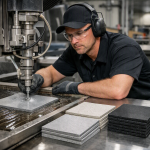
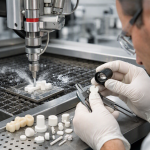
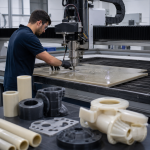
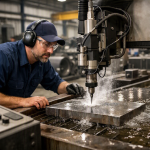
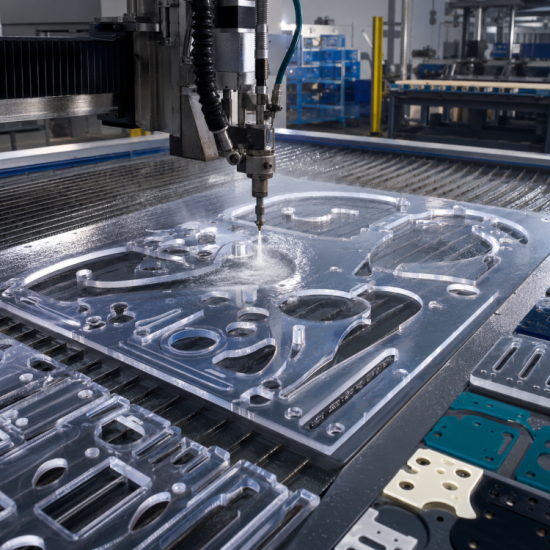

Plastic cutting services from Hydro-Lazer, Inc. utilize waterjet technology to cut 14 polymer types with tolerances as tight as ±.003″. This method supports precise shaping while maintaining the original properties of each material. Components are produced with consistency suited for demanding applications. Industries rely on this process to meet strict engineering standards.
Waterjet cutting preserves the structure and chemical composition of polymers through a cold-cutting approach. Materials remain stable throughout fabrication, supporting long-term performance. Hydro-Lazer operates from Freeport, Pennsylvania, and has served diverse industries since 1985. Their work reflects experience, precision, and a strong commitment to quality outcomes.
Waterjet Plastic Cutting for Aerospace: Preserving Polymer Integrity in Safety-Critical Applications
Advanced aerospace applications rely on stable material behavior. Aerospace polymer components require cutting methods that keep material properties exactly as specified. Waterjet cutting maintains these conditions through a cold cutting process. Structural integrity and chemical composition remain unchanged throughout production.
Controlled processing protects sensitive polymers during fabrication. Fluoropolymers, thermosets, epoxy resins, and polyurethane are processed without exposure to heat. Clean cut lines are achieved with no distortion or surface alteration. Calibrated pressure and speed settings align with each material specification.
Reliable tolerances support precise assembly requirements. Accuracy is maintained within ±.003 inches on compatible materials. CNC-controlled systems execute programmed cut paths with consistency. Verified capabilities and documented performance support vendor qualification for aerospace polymer component work.
Waterjet Plastic Cutting for Automotive: Complex Shapes and Consistent Dimensions Across Production Runs
Automotive manufacturing relies on uniform part geometry across production cycles. Automotive plastic components require consistent geometry across every unit in a production run. Waterjet cutting supports this requirement through a programmed process that precisely reproduces each cut path. Variation between parts is minimized through controlled execution.
Hydro Lazer processes a range of automotive polymers with precision control. Nylon, PVC, PET, polyolefins PO, and polyurethane PUR are cut using waterjet technology while maintaining clean edges and structural stability. Bur-free finishes are produced without deformation across complex and simple geometries. Material form remains consistent throughout each production batch.
CNC-driven cutting enables the flexible production of automotive parts. Cut paths are generated from CAD files or hand sketches and executed with repeatable accuracy across production volumes. Automotive plastic components are delivered in assembly-ready condition without secondary finishing or additional edge processing. Programmed execution supports efficient handling of multiple component designs.
Industrial Plastic Cutting Services for Oil and Gas, Marine, and Construction: One Fabricator Across the Full Polymer Spectrum
Oil and gas pipeline facilities, marine pump manufacturing centers, and construction industry buyers all need a plastic cutting service that handles the full range of polymers under one roof. Hydro-Lazer serves all three sectors and cuts every major polymer category used across those industries.
Waterjet handles the complete industrial polymer spectrum, including thermoplastics, thermosets, elastomers, biodegradable plastics, expandable polystyrene (EPS), and all named polymer types in Hydro-Lazer’s compatibility list. Cutting speed is matched to each substrate individually, preserving material integrity regardless of the polymer’s thermal or mechanical sensitivity.
For industrial-scale procurement, two factors stand out. First, precision cutting minimizes material waste across large runs. Second, waterjet cutting produces no fumes during processing, which supports facilities that operate under safety and environmental compliance requirements. Hydro-Lazer’s pricing makes waterjet procurement viable at industrial volumes across all project scales.
Plastic Materials Compatible With Hydro-Lazer’s Waterjet Cutting System
Hydro-Lazer’s waterjet cutting system is compatible with the following fourteen polymer materials:
- Nylon
- Acrylic
- Thermoplastics
- Thermosets
- Biodegradable Plastics
- Elastomers
- Epoxy Resins
- Expandable Polystyrene (EPS)
- Fluoropolymers
- Polyolefins (PO)
- Polystyrene (PS)
- Polyurethane (PUR)
- Polyethylene Terephthalate (PET)
- Polyvinyl Chloride (PVC)
Hydro-Lazer applies the appropriate cutting speed for each polymer type to ensure clean cuts that preserve the material’s physical and chemical properties.
Waterjet vs. Laser and Mechanical Cutting for Plastics: Why Cold Cutting Preserves What Other Methods Destroy
The cutting method applied to a plastic component determines whether the material arrives at assembly with its specified properties intact.
Laser Cutting vs. Waterjet for Plastics
Laser cutting introduces heat at the cut line. For heat-sensitive polymers, including PVC, PET, and fluoropolymers, heat alters the molecular structure at the cut edge. Laser cutting of plastics also generates toxic fumes from thermal polymer degradation, creating facility compliance requirements that waterjet processing avoids. For precision polymer cutting in aerospace and industrial plastic cutting service applications where dimensional accuracy and material property preservation are both required, waterjet is the technically sound choice.
Mechanical Cutting vs. Waterjet for Plastics
Mechanical cutting introduces stress distortion through physical contact with the material. On intricate geometries, that contact produces burrs and dimensional variation that require secondary finishing before the part is assembly-ready. For complex-profile polymer components commonly specified for automotive and industrial applications, waterjet produces clean, burr-free edges in a single pass, eliminating the need for additional processing steps.
Why Waterjet Is the Correct Method for Precision Polymer Cutting
Waterjet cutting introduces zero heat and zero mechanical contact force. Polymer chemistry, surface finish, and dimensional geometry are all preserved through the cutting process. The part exits the cutting process with its specified material properties intact, its edges clean, and its dimensions within the tolerance range required for direct assembly. Waterjet also produces no fumes, making it a clean process for facilities with air-quality compliance requirements.
Request a Plastic Cutting Quote From Hydro-Lazer, Inc.
Hydro-Lazer accepts project inputs in hand sketches or CAD drawings and has served customers across the manufacturing, automotive, construction, oil and gas, and marine industries since 1985.
Hydro-Lazer, Inc. 134 Armstrong Drive Freeport, PA 16229 Phone: 724-295-9100 Email: john@hydro-lazer.com
Submit CAD files, part drawings, or material specifications for any polymer type to receive a quote. Hydro-Lazer’s team will confirm material compatibility, cutting tolerances, and production timeline based on the specific requirements of each project.
Frequently Asked Questions
What is the best plastic cutting service for aerospace polymer components?
Waterjet cutting is the technically correct method for aerospace plastic components because it introduces zero heat and preserves the molecular structure and chemical properties of heat-sensitive polymers such as fluoropolymers, thermosets, and epoxy resins.
Hydro-Lazer, Inc. provides waterjet plastic cutting services compatible with all three polymer types at tolerances within ±.003″ on qualifying materials. Aerospace procurement engineers should evaluate vendors against a documented material compatibility list and confirmed tolerance capability before qualifying a cutting service for safety-critical polymer work.
Can waterjet cutting handle fluoropolymers without heat damage?
Yes. Waterjet cutting is a cold-cutting process that introduces no heat at any point during the cutting operation. Fluoropolymers are heat-sensitive materials that undergo molecular changes when cut with thermal methods such as laser cutting, and waterjet eliminates that concern. Hydro-Lazer’s waterjet system is documented as compatible with fluoropolymers and cuts them without altering physical or chemical properties.
What plastics can waterjet cutting handle?
Waterjet cutting is compatible with a broad range of polymers, including thermoplastics, thermosets, elastomers, fluoropolymers, epoxy resins, nylon, acrylics, PVC, PET, polyolefins, polyurethanes, polystyrene, expandable polystyrene, and biodegradable plastics.
Hydro-Lazer’s waterjet system is documented as compatible with all fourteen of those polymer categories. Cutting speed is calibrated to each specific polymer substrate to ensure clean cuts that preserve the material’s physical and chemical integrity.
Is waterjet cutting better than laser cutting for plastics?
For precision polymer work, waterjet cutting outperforms laser cutting on two critical criteria: it introduces zero heat at the cut line and produces zero toxic fumes from thermal polymer degradation.
Laser cutting alters the molecular structure of heat-sensitive plastics, including PVC, PET, and fluoropolymers, at the cut edge, rendering them unsuitable for aerospace and other precision applications. Waterjet preserves polymer chemistry, surface finish, and dimensional geometry in a single pass, eliminating the need for secondary finishing.
What tolerances can waterjet plastic cutting achieve?
Hydro-Lazer’s waterjet cutting system achieves tolerances within ±.003″ on compatible plastic materials. That level of dimensional accuracy meets the fit-and-assembly requirements for aerospace and automotive polymer components, where variation between parts can lead to downstream failures.
Tolerances are maintained through CNC-controlled cut paths programmed from CAD drawings or hand sketches, which eliminates operator-introduced dimensional drift across production runs.
Who provides precision polymer cutting for automotive components in Pennsylvania?
Hydro-Lazer, Inc., based in Freeport, Pennsylvania, provides waterjet plastic-cutting services for automotive polymer components, including nylon, PVC, PET, polyolefins, and polyurethane. The process produces clean, burr-free edges without distortion, delivering parts assembly-ready without secondary finishing. Hydro-Lazer has served customers in the automobile industry as a documented application vertical and accepts part specifications as CAD files or hand sketches.
Does waterjet plastic cutting produce burrs or require secondary finishing?
Waterjet cutting produces clean, burr-free edges on plastic components in a single pass, without the mechanical contact force that causes stress distortion. Parts cut by Hydro-Lazer’s waterjet system arrive assembly-ready and require zero deburring, edge finishing, or dimensional re-inspection. This is a direct operational advantage over mechanical cutting methods for complex-geometry polymer components.
What industries does Hydro-Lazer serve with plastic cutting services?
Hydro-Lazer provides plastic cutting services to customers in aerospace, automotive, construction, oil and gas pipeline, and marine pump manufacturing industries. All five sectors are documented application verticals for Hydro-Lazer’s waterjet plastic cutting operations. The company has served customers across those industries since 1985 and accepts project inputs ranging from full CAD drawings to hand sketches for any compatible polymer type.
Is waterjet cutting suitable for industrial-scale plastic cutting procurement?
Yes. Hydro-Lazer’s waterjet plastic cutting services are priced competitively for industrial-volume procurement across all project scales. Precision cutting minimizes material waste across large runs, and CNC-controlled cut paths are repeatable across production volumes without dimensional drift. Industrial facilities also benefit from zero fumes during processing, which supports compliance with air quality and safety regulations.
How does Hydro-Lazer handle different plastic cutting project inputs?
Hydro-Lazer accepts project specifications as CAD drawings or hand sketches and programs cut paths to exact specifications under CNC control. There are zero tooling changes required between polymer types or part geometries, which simplifies procurement for buyers managing multiple component specifications. To submit a project for quoting, contact Hydro-Lazer at 724-295-9100 or john@hydro-lazer.com, or send files to 134 Armstrong Drive, Freeport, PA 16229.