

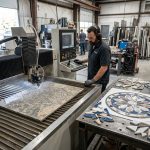
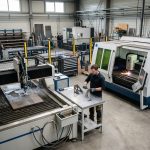
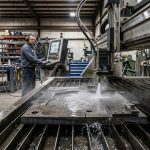
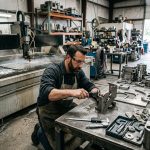
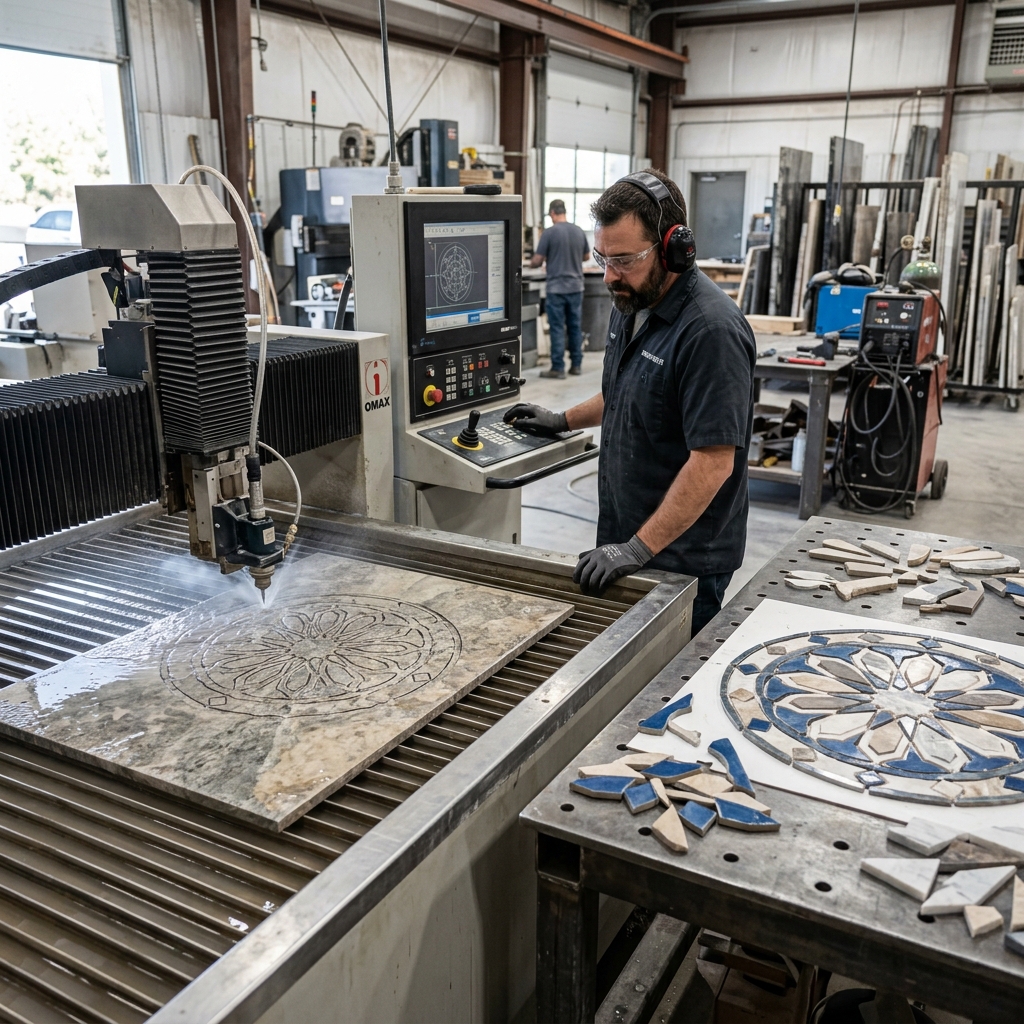

For decorative floors with curves, points, and fitted pieces, waterjet tile cutting is the right tool. It uses a high-pressure stream of water and abrasive to shape tile and stone into clean, accurate parts. Custom tile inlays, tile floor medallions, logos, and curved borders all come out sharp and consistent.
Conventional tools suit straight cuts on standard field tile. When a design depends on tight joints and smooth curves, waterjet precision gives the floor a planned, finished look. At Hydro-Lazer, we have specialized in waterjet cutting and precision flooring inlays since 1985.
Our systems use a 50,000 PSI stream to cut material up to 8″ thick, with pieces up to 9 ft × 12 ft. This guide covers when the process makes sense and which materials and designs suit it. It also explains what to prepare before you request a quote.
When Is Waterjet Worth Using for Tile?
Waterjet earns its place when the cut shape matters as much as the tile itself. Wet saws handle straight lines well, and waterjet tile cutting handles tight radii, inside corners, and detailed profiles. Each shape comes out clean and repeatable, piece after piece.
Several design features point toward waterjet. Round medallions, arcs, and flowing borders need smooth edges all the way around, and interlocking inlay pieces need matching cuts for tight joints. Lettering, logos, thin lines, and patterns repeated across a large lobby also benefit from CNC consistency.
Designs that mix materials are another strong fit, since one digital file guides every cut in porcelain, marble, and stone. As a cold process, waterjet tile cutting keeps brittle surfaces free of heat-affected zones and mechanical stress. Tile and stone edges stay clean and intact, so visible inlay pieces arrive ready to set.
Inlays, Borders, Logos, and Medallions
Custom tile inlays set one material into another so the finished surface reads as one flat plane. Contrasting shapes, stripes, and motifs require a precise cutout and a matching insert. We produce hard surface inlays in porcelain, marble, ceramic, slate, and accent tile for strong color and texture contrast.
Borders frame a room, define walkways, and mark transitions between spaces. Curved, scalloped, or interlocking borders follow the floor plan closely, and waterjet tile cutting keeps every repeated piece consistent. Logos and lettering for lobbies, schools, hotels, and storefronts are cut from vector files, so the artwork keeps its true proportions.
Tile floor medallions often serve as the focal point of a foyer, rotunda, or entry. Compass roses, florals, starbursts, and custom crests rely on dozens of pieces meeting at precise angles. Our waterjet medallions include natural stone, tile, vinyl, and mosaic designs to match or contrast with the surrounding floor.
Material and Design Considerations
Porcelain is dense and hard, which makes it a favorite for commercial floors with heavy traffic. Porcelain waterjet cutting shapes this tough material along curves with clean, chip-free edges. Our porcelain tile guide covers this material in full detail.
A marble inlay brings a classic look to upscale homes and hospitality floors. Natural stone varies in veining, density, and fissures, so careful slab selection protects thin design sections. Ceramic cuts easily, slate needs care with pointed pieces, and accent tiles add color and finish variety.
Good design choices make waterjet tile cutting smooth from start to finish. Slightly wider narrow sections hold up well in brittle materials, and matching tile thickness keeps the floor level. Decide early whether pieces will fit tightly or sit with a grout line, and plan seam locations for large medallions that ship in sections.
From Artwork to Cut Components
Every project starts with a design concept, and we work from hand sketches or CAD drawings. A rough sketch with dimensions starts the conversation, and a finished vector file speeds things up. Our team converts artwork into cut paths using offline programming and CAD digitizing software.
File refinement is the stage for adjusting piece sizes, confirming joint allowances, and assigning a material to each section. Confirming tile type, finish, and thickness here keeps the final layout consistent. CNC and optical equipment then guide the cut, holding complex shapes within a .003″ tolerance on certain materials.
That level of accuracy makes waterjet tile cutting ideal for inlay pieces that nest tightly together. Medallions and inlays often contain many parts, so labeling or a dry fit helps the installer assemble the design on site. Ask about layout guides or piece numbering when you request your quote.
What to Send for a Custom Tile Quote
Complete project details lead to a fast, accurate quote for waterjet tile cutting. Start with artwork or drawings, such as CAD files (DXF/DWG) or vector artwork (AI, EPS, SVG, PDF). A dimensioned sketch also works well for early pricing.
Include the finished size of the medallion, inlay, or border along with the space it will fill. List the tile or stone type, color, finish, and thickness for each section, and note whether you will supply material or need it sourced. Share the quantity, from one feature piece to a repeating pattern across a large area.
Joint details matter too, so specify tight fit or grouted joints and the grout width. Project context helps as well, including residential or commercial use, floor or wall placement, timeline, and reference photos. Browse our photo gallery for inspiration, then request a custom medallion or inlay quote with your files.
FAQs
How does waterjet cutting work on tile?
A CNC machine guides a high pressure stream of water and abrasive along a digital cut path. This process, known as waterjet tile cutting, shapes tile and stone into curves, inlays, logos, and medallions. The cold cutting action keeps brittle edges clean and sharp.
Can porcelain tile be waterjet cut?
Yes, porcelain is one of the most common materials for waterjet work. Its density and hardness call for a precise process, especially along curves. Waterjet gives porcelain smooth, clean edges ready for installation.
What is the difference between a tile inlay and a medallion?
An inlay is any shape or pattern of one material set into another with a flush surface. A medallion is a specific type of inlay, usually a standalone centerpiece such as a compass rose or crest. Medallions often include many interlocking pieces and anchor a room’s look.
What file format works best for a custom tile inlay?
Vector files such as DXF, DWG, AI, EPS, or SVG convert easily into cut paths. A dimensioned hand sketch is also a solid starting point, since CAD software can digitize it. Clean files shorten the design and quoting process.
How precise is waterjet cutting for tile?
CNC and optical equipment guide every cut along the programmed path. At Hydro-Lazer, we cut complex shapes and contours within a .003″ tolerance on certain materials. Final precision with waterjet tile cutting depends on the material and the design.
Can marble and porcelain be combined in one floor design?
Yes, mixed material designs are common in custom flooring. Each section is cut from the same digital file, so marble, porcelain, ceramic, and stone pieces fit together accurately. Matching tile thickness across materials keeps the finished floor level.
How large can a waterjet floor medallion be?
We produce pieces up to 9 ft × 12 ft. We can cut and deliver very large medallions in sections for easier handling and installation. Planning seam locations during design keeps pattern breaks discreet.
How can a designer request a tile cutting quote?
Gather your artwork, dimensions, materials, quantity, and joint details first. Send everything through our quote request form for review. Complete information makes waterjet tile cutting quotes fast and accurate.