
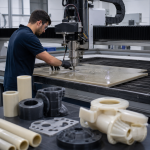
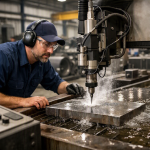
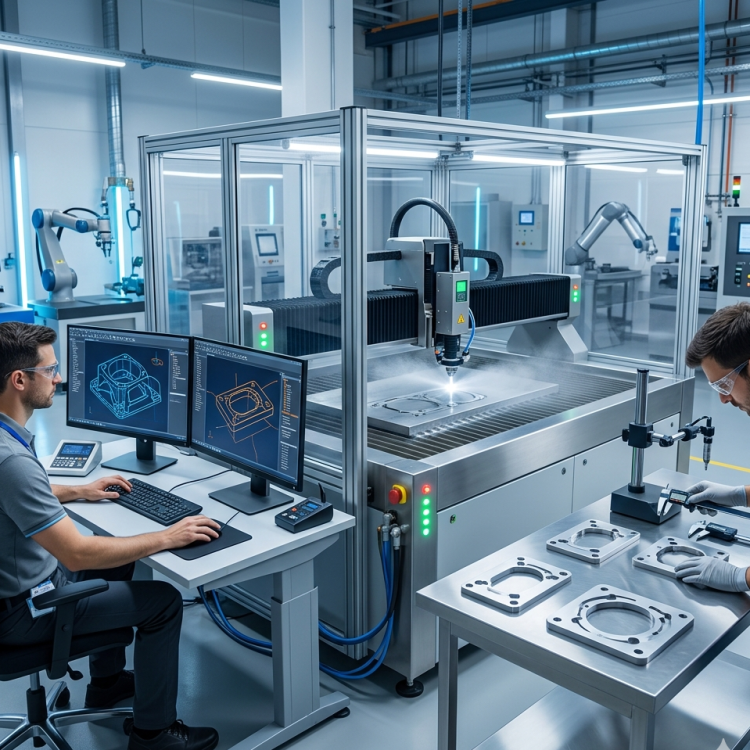

Custom water-jet cutting produces finished parts that meet specifications on the first cut when the vendor manages every stage from file submission to part output with documented precision.
Hydro-Lazer, Inc., founded in 1985 and located in Freeport, PA, delivers a four-stage fabrication workflow that takes a CAD file or hand sketch and produces a burr-free, dimensionally accurate part that requires no secondary finishing. Certified to MIL-I-45208A and carrying a proven track record across more than 10,000 completed jobs, Hydro-Lazer has operated within stipulated deadlines, budgets, and quality parameters for over four decades. The technology alone sets the foundation. The process discipline built around it delivers the finished result.
From CAD File or Hand Sketch to Programmed Cut Path
The first stage of Hydro-Lazer’s process begins with file input and a practical design decision: no proprietary file format is required for submission. Engineers can submit standard CAD drawings. Clients without digital files can submit hand sketches. Both input types are accepted and processed through the same controlled translation workflow.
Once a design is received, it is rendered into a machine-ready cut program using offline programming and CAD digitizing software. This is the stage where the design becomes a precise set of cutting instructions, before the cutting head moves and before any material is touched. Offline programming is the first point at which dimensional accuracy is established.
Why Offline Programming Determines Output Accuracy
Programming the cut path offline means that potential dimensional errors are identified and corrected in software. A cut path verified before execution produces consistent results on the cutting table. Custom water jet cutting from a CAD file is only as accurate as the program driving it. Hydro-Lazer’s offline programming stage ensures that the program is correct before a single pass is made.
The machine can be programmed to cut any design and shape using standard CAD/CAM systems. Complex geometries, tight contours, and irregular profiles are all programmable with full geometric flexibility. A correctly programmed cut path is the prerequisite for a rework-free output on every job.
How Cutting Parameters Are Matched to Material Requirements
The second stage addresses a critical point that equipment capability alone cannot solve: material-specific parameter selection. CNC waterjet cutting tolerances are maintained when the cutting speed, water pressure, and abrasive delivery rate are correctly matched to the specific material being cut. Hydro-Lazer’s workforce carries in-depth knowledge of the composition, form, and characteristics of a wide range of materials. That material expertise is the basis for every parameter decision made before cutting begins.
The correct cutting speed is applied to each material to ensure neat cuts without altering its physical or chemical properties. Water pressure is adjusted to match material requirements across the full range of substrates. Hydro-Lazer cuts, from metals and composites to plastics, stone, and glass. No machine adjustment is required when switching between materials, enabling continuous parameter optimization and eliminating retooling delays.
Parameter Selection Is Where Quality Is Secured
Edge defects such as burrs, micro-cracks, delamination, and heat-affected zones are prevented before cutting by selecting parameters that the material can accept without distortion. Hydro-Lazer’s adaptive parameter selection eliminates that failure mode at the source. The right parameters for the right material mean the cut arrives correctly on the first pass, every time.
CNC Controlled Multi-Axis Cutting and How Tight Tolerances Are Maintained
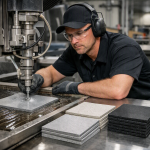
The third stage is cutting execution, and this is where Hydro-Lazer’s CNC precision is substantiated with documented specifications. Cutting is carried out using CNC-controlled multi-axis cutting machines, guided by the programmed cut path established in stage one and the material-matched parameters confirmed in stage two. The outcome is a cutting operation that maintains tight tolerances and exacting specifications across every part in a run.
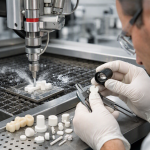
Hydro-Lazer holds cutting tolerances within ±.003″ on certain materials. The system operates at 50,000 PSI, enabling consistent depth and edge quality on virtually any material up to 8 inches thick. Leading CNC and optical equipment are used to accurately cut complex shapes and contours, with the optical equipment providing inline quality verification during the cutting process.
The Physical Characteristics That Make Waterjet Precision Repeatable
Two physical properties of the waterjet process enable the tolerance consistency required by CNC precision. There is no direct contact between the waterjet stream and the cutting surface, which means no tool pressure, no clamping distortion, and no workpiece deflection from cutting forces. No heat is generated during cutting.
The part that leaves the cutting table retains its full material properties, dimensionally and structurally intact. These characteristics make tolerance consistency repeatable across the full production run, whether the job involves a single prototype or a high-volume contract.
Burr-Free, Dimensionally Accurate Parts That Require No Secondary Tooling
The fourth stage is the output stage, where the process discipline established in the first three stages is validated. Abrasive custom water jet cutting produces burr-free cuts with smooth, clean edges, eliminating the need for secondary tooling. No deburring. No grinding. No secondary finishing operations of any kind. The part that comes off Hydro-Lazer’s cutting table is the finished part.
Component strength is retained through the cutting process. Because no heat is introduced and no mechanical distortion is applied, the material’s physical properties at the cut zone remain identical to its properties in the bulk. High-quality part finish is a standard output characteristic, and parts are cut to exacting specifications with optimum precision and close tolerances that match the programmed input from stage one.
The Operational Value of First-Cut Accuracy
For engineers and procurement managers evaluating a custom water jet cutting vendor, first-cut accuracy carries direct cost consequences. Rework cycles consume machine time, material, labor, and schedule.
A vendor whose process produces a finished part on the first cut eliminates those downstream costs before they are incurred. Hydro-Lazer has delivered that outcome across more than 10,000 completed jobs since 1985, within stipulated deadlines, budgets, and quality parameters.
Industries That Depend on First-Cut Accuracy From Custom Waterjet Cutting
Custom Water Jet Cutting
Serves industries where first-cut accuracy is a specification requirement. Hydro-Lazer works across a documented range of sectors and application types where the rework elimination argument is built into the production standard.
Aerospace
Demands cutting tolerances that match engineering drawings. Dimensional drift is a condition that requires immediate attention when parts are destined for structural or safety-critical assemblies.
Medical Device Manufacturing
Treats part accuracy as a patient safety parameter. Finished parts must match the specification with precision that supports quality assurance documentation.
Semiconductor Fabrication
Requires precision cutting in environments where material contamination and edge quality are controlled process variables. The cold, contact-free waterjet process is compatible with the sensitivity of semiconductor substrates.
Construction and Architecture
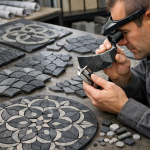
Specify custom waterjet-cut parts, including flooring inlays, cladding panels, and architectural sign components, that must fit at installation without field correction. A part cut to specification eliminates the labor cost of an out-of-spec component at the job site.
Manufacturing, Mining, Power Generation, and Agriculture
Rely on production consistency across contract runs. Hydro-Lazer cuts brackets, chassis, custom panels, tubular frames, electronic enclosures, and electro-mechanical assemblies for OEM clients and fabrication centers who require part-to-part repeatability across the full run.
Submit Your CAD File or Design Sketch for a Custom Waterjet Cutting Quote
Hydro-Lazer, Inc. accepts CAD files and hand sketches for custom water-jet cutting projects of any material, geometry, quantity, or complexity. No project is too large or too small. From single-piece prototypes to full production runs, every job follows the same four-stage process: offline programming, parameter selection, CNC cutting, and verified finished part output.
Hydro-Lazer, Inc. 134 Armstrong Drive, Freeport, PA 16229 Phone: 724-295-9100 Email: john@hydro-lazer.com
Submit your design via Hydro-Lazer’s RFQ page or contact the team directly to discuss material, tolerance, and lead-time requirements. The file submission is the starting point. A finished part that meets the specification is the outcome.
Frequently Asked Questions
How does custom water jet cutting work from a CAD file?
A CAD file submitted to a waterjet cutting vendor is converted into a machine-ready cut program using offline programming and CAD digitizing software. The programmed cut path is verified before cutting begins, and the CNC cutting system executes the path to the tolerances specified in the design. Hydro-Lazer processes both standard CAD drawings and hand sketches through this workflow.
What file formats does waterjet cutting accept?
Most waterjet cutting vendors, including Hydro-Lazer, accept standard CAD file formats with no proprietary submission format required. Hydro-Lazer also accepts hand sketches, which are digitized and converted into cut programs using CAD digitizing software before programming begins.
How accurate is CNC waterjet cutting?
CNC waterjet cutting maintains tight dimensional tolerances, and Hydro-Lazer holds tolerances within ±.003″ on certain materials. Accuracy is determined by the combination of a correctly programmed cut path, material-appropriate cutting parameters, and a CNC system that executes the path without mechanical contact or heat distortion.
Does waterjet cutting require secondary finishing or deburring?
Abrasive waterjet cutting produces burr-free cuts with smooth, clean edges that require no secondary tooling, deburring, or finishing operations. The part that comes off the cutting table is the finished part, with no post-cut correction needed when parameters are correctly matched to the material.
What materials can be cut with custom waterjet cutting?
Waterjet cutting is compatible with virtually any material, including metals, composites, plastics, ceramics, stone, glass, and rubber. Hydro-Lazer’s system operates at 50,000 PSI and cuts materials up to 8 inches thick, with cutting parameters adjusted to match the specific composition and characteristics of each material.
Can waterjet cutting handle complex shapes and contours?
CNC waterjet cutting can be programmed to cut any design, including complex geometries, tight contours, and irregular profiles, using standard CAD/CAM systems. The cutting head follows the programmed path with the same precision on a complex contour as on a straight edge.
Does waterjet cutting create heat-affected zones?
Waterjet cutting generates no heat during the cutting process, which means there are no heat-affected zones, no thermal distortion, and no work hardening at the cut edge. The material’s physical and chemical properties are fully intact at the output stage, which is a primary reason waterjet cutting is specified for aerospace, medical, and semiconductor applications.
How do we get a quote for custom waterjet cutting?
Hydro-Lazer, Inc. accepts CAD files and hand sketches for quoting on any material, tolerance, quantity, or complexity level. Submit your design through the RFQ page or contact the team at 724-295-9100 or john@hydro-lazer.com. Hydro-Lazer handles single prototypes and full production runs through the same process.
What industries use custom waterjet cutting services?
Waterjet cutting is used across aerospace, medical device manufacturing, semiconductor fabrication, construction, architecture, manufacturing, mining, power generation, and agriculture. Applications include electronic enclosures, brackets, chassis, custom panels, tubular frames, electro-mechanical assemblies, flooring inlays, and architectural sign components.
How long has Hydro-Lazer been providing custom waterjet cutting? Hydro-Lazer, Inc. has provided custom water jet cutting services since 1985, with a documented track record of more than 10,000 completed jobs delivered within stipulated deadlines, budgets, and quality parameters. The company is certified to MIL-I-45208A and operates from its facility at 134 Armstrong Drive, Freeport, PA 16229.