

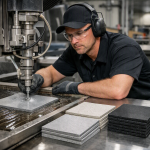
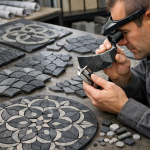
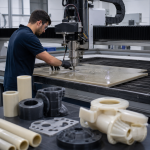
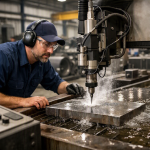


Slate tile waterjet cutting is a proven method for creating clean, detailed cuts in one of the most structurally sensitive natural stones available. Hydro-Lazer, Inc. in Freeport, PA, uses CNC-controlled multi-axis abrasive waterjet machines operating at 40,000 to 60,000 PSI to produce free-flowing designs with immense detail in slate tile.
Slate has a reputation for being difficult to cut. Buyers who have seen chipped edges or split tiles from diamond saw work often wonder whether any cutting method can handle slate without causing damage. That concern is valid. The answer comes down to the cutting mechanism and how it interacts with slate’s layered structure.
Does Slate Chip During Waterjet Cutting?
Chipping is the most common fabrication concern with slate, and it is a real issue when the wrong cutting method is used on a material with its layered structure.
How Chipping Happens With Conventional Cutting
Chipping along cut edges occurs when a cutting tool impacts the tile surface with lateral force. Diamond saws and rotary cutting tools apply mechanical contact force against the tile face. The impact stress propagates along slate’s natural cleavage planes, the parallel mineral layers that give slate its texture, and is released as chipping at the cut edge.
How Waterjet Keeps Edges Clean
Abrasive waterjet cutting applies zero mechanical contact force to the tile surface at any point during the cut. A high-velocity mixture of pressurized water and abrasive grit removes material without any tool contacting the slate. Impact stress is absent from the process, and cleavage planes are left undisturbed.
What the Output Shows
Hydro-Lazer’s abrasive waterjet machines produce free-flowing designs with immense detail in slate. Clean, detailed edges are only achievable when chipping is absent. Water pressure is adjustable across the 40,000 to 60,000 PSI operating range so that every cut meets the required expectations for the specific slate being used.
Will Waterjet Cause Slate to Crack?
Cracking in slate during fabrication originates from two sources: thermal shock and stress fractures. Both are consequences of cutting methods that introduce heat or impact force.
Why Heat and Impact Create Cracks
Laser cutting introduces a thermal gradient across the slate’s layered structure. Because the mineral layers in slate have different heat-absorption and expansion rates, an uneven thermal gradient produces internal stress that resolves as cracking along layer boundaries. Impact tools send fracture lines along natural cleavage planes, often well past the intended cut path. Slate’s laminated mineralogy makes it especially responsive to both of these conditions.
Why Waterjet Avoids Both
Abrasive waterjet cutting is a cold process. There is zero thermal gradient, zero thermal shock, and zero temperature differential across the tile surface. The non-contact cutting stream introduces no mechanical impact. A material that is sensitive to heat and mechanical shock is kept safe from both when a waterjet is used.
Pressure Calibrated to Slate
Water pressure on Hydro-Lazer’s machines is adjustable to ensure the end product meets required expectations. Parameters are set specifically for the slate’s structural properties. CNC-controlled multi-axis machines are preferred for slate tile waterjet cutting because the additional axis control allows consistent cutting parameters throughout, even for the most complex cut paths.
Does Slate Split When Cut Into Complex Shapes or Tight Radii?
Splitting is the failure mode that most limits what conventional tile cutting can achieve with slate. It is the reason many contractors tell clients that complex slate designs are impossible.
Why Splitting Occurs on Curved Paths
When a saw follows a curved or angled path, the direction of applied force changes relative to the slate’s fixed layer orientation. At each directional transition, a stress differential is created between the tool’s intended cut direction and the cleavage plane direction.
When that stress differential exceeds the bond strength between layers, the material follows the cleavage plane. The cut splits. The more complex the path, the greater the probability of splitting. This is a physical constraint of contact-based mechanical cutting on layered stone.
Why CNC Multi-Axis Waterjet Removes That Constraint
CNC-controlled multi-axis machines follow any programmed path, curves, tight radii, complex geometric shapes, and organic free-flowing lines, with consistent cutting parameters regardless of path direction.
Because zero mechanical force is applied to the slate surface, there is no directional stress to generate and no cleavage plane splitting to worry about. The cutting stream behaves the same way on a straight line as on a compound curve.
What This Means for Your Design
Hydro-Lazer’s machines cut intricate designs from large slabs of slate. The ability to cut complex patterns at scale confirms that splitting is a solved problem when the right technology is applied. A contractor who has said your slate design cannot be done is describing a limitation of the tool they use.
What Makes Slate’s Natural Structure an Asset in Waterjet Fabrication?
The layered structure that makes slate sensitive during conventional cutting is also what gives it organic character, color depth, and natural uniqueness. Waterjet cutting preserves all of those qualities.
Slate’s rough surface and organic look are due to its laminated mineralogy. Waterjet introduces zero heat and zero contact force, so surface texture and edge character are fully preserved through every cut. There is zero thermal discoloration and zero mechanical abrasion of the tile face.
Slate is available in gold, white, black, red, green, and gray. The full color range stays accessible because the waterjet keeps edges and surfaces free from discoloration. Every tile carries a natural, unique pattern, and waterjet’s precision honors that uniqueness.
Slate is extremely durable, slip-resistant, and easy to maintain, making it a strong choice for high-traffic areas. Individual tiles can be replaced with ease if damaged, which is a long-term advantage in commercial installations. These characteristics are fully preserved when slate tile waterjet cutting is the fabrication method.
Can Waterjet Cut Slate Into Free-Flowing Designs?
One common misconception about slate fabrication is that its layered structure limits cutting to straight lines or basic shapes. CNC multi-axis waterjet capability removes that limitation entirely.
Hydro-Lazer’s abrasive waterjet technology creates free-flowing designs with immense detail in slate. This is documented for Slate specifically. CNC-controlled multi-axis machines are preferred for slate because the multi-axis capability handles complex curves, organic paths, and compound geometries that define high-end floor inlays and architectural tile features.
Scale is also supported. Hydro-Lazer’s machines cut designs from large slabs of slate, so project ambition is never limited by slab size or equipment reach. The process is fast, efficient, and detailed, which supports both the design scope and the production timeline for commercial and residential projects.
Interior designers can combine slate with ceramic or porcelain tiles in mixed-material installations. Waterjet precision ensures that components cut from different materials fit accurately at shared edges, which is a requirement for clean mixed-material inlay work.
Is Slate Right for Both Commercial and Residential Installations?
Once fabrication accuracy is confirmed, performance in the actual installation environment is the next consideration.
Slate is extremely durable and easy to maintain in both commercial and residential settings. It is slip-resistant and well-suited for high-traffic areas, addressing the most common concern about natural stone in commercial facilities. Slate works as a wall tile as well as a floor tile, extending its use across multiple surfaces in any project.
Slate is available in gold, white, black, red, green, and gray, covering both residential design palettes and the wider range used in commercial interiors. Individual tiles are easy to replace if damaged, which reduces long-term maintenance demands in high-traffic facilities. Slate is a popular and versatile material in commercial and residential settings, with a strong track record across installation environments.
How to Submit a Slate Design to Hydro-Lazer for Fabrication
Getting a custom fabrication quote from Hydro-Lazer requires a design input and a material specification. The process is straightforward at any stage of design.
Hydro-Lazer accepts hand sketches and CAD drawings. Design is handled in-house, so any quantity, shape, and complexity level is within scope. Large slab capability and CNC multi-axis precision allow the fabrication process to scale from a single custom tile to a full commercial floor installation.
Submit a quotation request at hydro-lazer.com/rfq/ or contact the team using the information below.
Hydro-Lazer Slate Tile Waterjet Cutting Services in Freeport, Pennsylvania
Hydro-Lazer, Inc. 134 Armstrong Drive, Freeport, PA 16229 Phone: 724-295-9100 Email: john@hydro-lazer.com RFQ: hydro-lazer.com/rfq/
Service: Abrasive slate tile waterjet cutting, CNC multi-axis, 40,000 to 60,000 PSI. Slate colors available: gold, white, black, red, green, gray. Capabilities: Free-flowing designs, detailed inlays, mixed-material installations, large slab cutting, any quantity
Frequently Asked Questions
Does slate chip when it is cut with a waterjet?
Abrasive waterjet cutting applies zero mechanical force to the tile surface, eliminating the impact stress that causes chipping along slate’s natural cleavage planes.
Hydro-Lazer’s adjustable pressure settings ensure that cut parameters are calibrated to the slate’s structural properties. Clean edges are produced on every cut path, including detailed and curved ones.
Will waterjet crack slate tile during fabrication?
Cracking in slate during fabrication is caused by thermal shock or mechanical impact stress. Abrasive waterjet cutting is a cold, non-contact method that introduces zero heat and zero impact force. Both crack-initiating conditions are absent from the process.
Why does slate split when cut with a diamond saw?
Slate splits during diamond saw cutting because the saw’s mechanical contact force changes direction relative to slate’s fixed cleavage planes when the cut path curves or angles. The stress differential at each directional transition causes the material to deform along its natural planes. This is a physical constraint of contact-based mechanical cutting on layered stone.
Can curved and detailed patterns be cut in slate without splitting?
Yes, with CNC-controlled multi-axis abrasive waterjet cutting. Because the cutting stream applies zero mechanical contact force, there is zero directional stress when the cut path curves or follows complex geometry. Hydro-Lazer’s machines produce free-flowing designs with immense detail in slate, including tight radii and compound curves.
Is slate too difficult to cut for custom floor inlays?
Slate is difficult to cut with diamond saws and rotary tools due to its layered cleavage structure. Abrasive waterjet technology delivers accurate, detailed results on slate. A contractor who says a specific slate design cannot be done is describing a limitation of their cutting method.
What PSI is used for slate tile waterjet cutting?
Hydro-Lazer’s abrasive waterjet machines operate between 40,000 and 60,000 PSI, with pressure adjustable to meet the specific requirements of each slate project. Pressure calibration ensures that the cutting force is appropriate for clean material removal on slate’s layered structure.
Does waterjet cutting change the color or surface texture of slate?
Abrasive waterjet cutting generates zero heat and makes zero mechanical contact with the tile face. Edges stay true to their original color, surface texture is preserved, and the natural character of the slate carries through to the finished piece.
Can slate tile be cut alongside ceramic or porcelain in a mixed-material installation?
Yes. Hydro-Lazer’s waterjet cutting capability supports mixed-material installations that combine slate with ceramic or porcelain tiles. Waterjet precision ensures accurate edge tolerances between components cut from different materials, which is required for clean seams in inlay and feature floor work.
Is slate durable enough for commercial high-traffic floors?
Slate is extremely durable, slip-resistant, and well-suited for high-traffic areas. It is easy to maintain, and individual tiles can be replaced with ease if damaged, which is a practical advantage in commercial facilities.
How do we get a quote for custom slate tile waterjet cutting?
Submit a request for quotation at hydro-lazer.com/rfq/ or contact Hydro-Lazer, Inc. at 724-295-9100 or john@hydro-lazer.com. Hydro-Lazer accepts hand sketches and CAD drawings and handles design in-house for projects at any stage.