

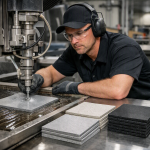
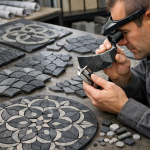
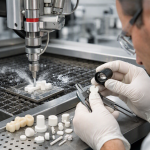
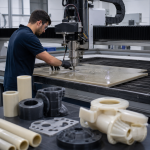
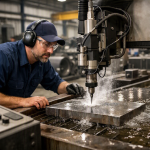
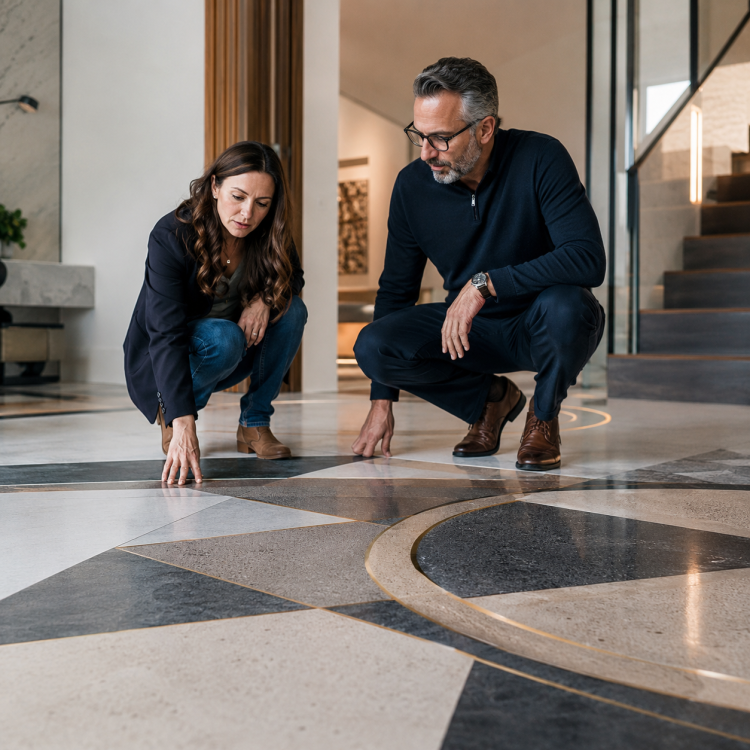

Hard-surface floor inlays are custom-cut tile compositions permanently set into a finished floor, creating borders, medallions, emblems, and decorative patterns that work beautifully in both homes and commercial buildings. Hydro-Lazer, Inc., a waterjet fabrication company founded in 1985 in Freeport, PA, produces them for government facilities, hospitality properties, commercial spaces, and residential projects of every scale.
Which Hard Surface Tile Materials Are Available for Custom Floor Inlays?
Choosing the right tile material is the first and most consequential decision in any floor inlay project. Each material brings a distinct combination of durability, appearance, and installation behavior. Hydro-Lazer fabricates hard surface floor inlays across the full range of tile types used in professional flooring work.
Porcelain
Porcelain is one of the most widely used materials for floor inlays in residential and commercial settings. Its high density and strength allow it to withstand heavy foot traffic without surface wear. It is resistant to moisture, scratches, and staining, requires minimal maintenance, and comes in a wide range of colors, textures, and natural stone finishes. Waterjet cutting adds to porcelain’s natural sheen, a direct benefit of the cold-cutting process.
Marble
Marble is the traditional choice for premium floor inlays, particularly for border designs, medallions, and decorative centerpieces in high-end residential and hospitality spaces. It is extremely durable, available in numerous natural color variations, and highly resistant to staining and moisture when properly sealed. Marble floor inlays can last for decades without losing visual quality.
Ceramic
Ceramic tile works well for inlays, signs, and medallions. Waterjet technology cuts intricate ceramic designs at high speed without cracking or chipping the material, which is a key advantage over mechanical cutting methods. Ceramic inlays are a practical option for corporate lobbies, educational buildings, and any space that needs a custom design element at a manageable material cost.
Slate
Slate offers a rough, organic surface texture that sets it apart visually from polished tile materials. It is naturally slip-resistant, making it a solid specification for high-traffic areas and exterior transitions. Slate comes in gold, white, black, red, green, and gray, and works for both floor inlays and wall tile applications. Individual slate tiles can also be replaced without disturbing the surrounding installation if one piece is damaged.
Accent Tiles
Accent tiles serve a finishing role in inlay work, adding decorative detail in kitchens, bathrooms, countertops, and floor borders. They are available in a wide range of patterns and designs and integrate cleanly into complex multi-material inlay compositions.
Are Hard Surface Floor Inlays Suitable for High-Traffic Commercial Environments?
One of the most common questions about hard-surface floor inlays is whether they hold up in areas with heavy daily foot traffic. The performance record of the materials Hydro-Lazer works with, combined with the precision of waterjet fabrication, makes the answer straightforward: yes, across multiple material types.
Porcelain withstands immense foot traffic and is a standard specification in commercial malls, corporate offices, and educational institutions because its surface resists wear under continuous use.
Marble handles high volumes of foot traffic and produces inlays that last for decades when fabricated and installed correctly. Slate is inherently slip-resistant, making it a sound option for building entries and public corridors.
Hydro-Lazer’s hard-surface floor inlays have been installed in government facilities, commercial buildings, hospitality properties, and residential projects. The material range covers the full durability spectrum, from slip-resistant natural stone to dense, scratch-resistant porcelain, so the right material for any commercial specification is available regardless of traffic level or use type.
What Design Possibilities are Available for Residential Floor Inlay Projects?
Homeowners often assume that the level of design complexity found in luxury hotels or corporate lobbies is beyond the reach of a residential renovation. Waterjet fabrication enables a wide range of designs to be realized at the residential scale.
Hydro-Lazer produces emblems, logos, custom decorative patterns, marble flooring border designs, and full medallion compositions for residential clients. Marble border designs are available as standalone commissions, so a homeowner can add a fabricated inlay element to an entryway, hallway, or bathroom floor without commissioning a full-room redesign. Accent tiles allow kitchens, bathrooms, and countertop edges to receive custom pattern work that integrates with the surrounding hard surface material.
Slate tiles can produce naturalistic compositions with organic visual texture. Interior designers often combine slate with ceramic or porcelain tiles for mixed-material inlay designs that deliberately use the textural contrast between the materials. Hydro-Lazer handles inlay design in-house so that clients can bring a concept, a reference image, or a rough sketch. Production capability extends to inlay panels up to 9 ft x 12 ft, and any quantity can be produced, from a single residential accent piece to a large-scale commercial medallion installation.
How Does Waterjet Cutting Preserve the Natural Beauty of Hard Surface Tiles?
The cutting method used to fabricate floor inlay pieces directly affects whether the finished tile retains its natural finish or arrives with damaged edges and discoloration.
Waterjet cutting is a cold-cutting process. It uses a high-pressure water stream without generating heat at the cut point. Because no heat is introduced, there are no heat-affected zones.
The discoloration, micro-fracturing, and structural stress that thermal and friction-based cutting methods can create in natural stone and ceramic tile are avoided entirely. The tile’s natural sheen, color depth, and surface texture are fully preserved through the cut.
Waterjet-cut edges are burr-free. Tiles arrive from fabrication with clean, precise edges that require no secondary grinding, polishing, or manual finishing before installation. For porcelain specifically, waterjet cutting is documented to add to the tile’s natural sheen. For marble and slate, the cold process means the stone’s inherent coloration and surface character remain intact at the cut edge.
How Precise Is Waterjet Cutting for Floor Inlay Work and Why Does That Matter at Installation?
Precision in floor inlay fabrication ensures installed inlays look exactly as designed, with tight joints and no visible gaps between pieces.
Hydro-Lazer’s waterjet cutting achieves tolerances as close as ±0.003 inches on certain materials. CNC and optical equipment are used to accurately cut complex shapes and contours across all hard surface tile types.
The cutting process is fast, flexible, and highly repeatable. A single pattern can be reproduced numerous times with consistent dimensional accuracy, which matters for any inlay project that uses repeated design elements or requires multiple matching panels.
For ceramic tile, waterjet cutting reduces process time compared to traditional cutting tools while maintaining precision. Across all materials, the repeatability of CNC-controlled waterjet cutting means complex multi-piece inlay compositions fit together at installation as designed, without field modification or secondary cutting. Pieces arrive installation-ready.
How Do Customers Submit Their Floor Inlay Design to Hydro-Lazer?
Getting a custom floor inlay fabricated starts with a design, and Hydro-Lazer accepts them in the format that is most practical for the client.
Clients can submit hand sketches or CAD drawings. There is no requirement to produce files in a proprietary format or to arrive at a finished technical drawing. For clients who have a design concept without a finished file, Hydro-Lazer handles inlay design in-house. Customers can bring concepts or rough drawings, and the team works from that input. Designs are rendered using offline programming and CAD digitizing software before fabrication begins.
A residential homeowner with a sketch on paper and an architect submitting a complete CAD package both enter the same fabrication process. The starting point for any project is intentionally accessible.
Are Hard Surface Floor Inlays Easy to Maintain After Installation?
Long-term maintenance is a practical concern for homeowners and facility managers evaluating a floor inlay investment. The hard surface tile materials used in Hydro-Lazer’s hard surface floor inlays have well-documented maintenance profiles.
Marble is extremely resistant to stains and moisture and is easy to clean, making it a low-maintenance material relative to its premium visual character. Porcelain is similarly resistant to moisture, scratches, and staining and requires no specialized cleaning products or procedures.
Slate is extremely durable and easy to maintain. Because individual slate tiles can be replaced if damaged without removing the surrounding installation, it carries a practical maintenance advantage for commercial facilities.
Waterjet-cut pieces arrive burr-free and installation-ready, reducing the risk of edge chipping or surface damage during handling and installation. The installed inlay stays in the same condition it left fabrication.
Ready to Start a Hard Surface Floor Inlay Project? Here Is How to Get a Quote From Hydro-Lazer.
Hydro-Lazer, Inc. fabricates hard surface floor inlays for residential, commercial, hospitality, and government projects of any size, in porcelain, marble, ceramic, slate, and accent tile materials, at any design complexity, from hand sketch to CAD file.
Hydro-Lazer, Inc. 134 Armstrong Drive, Freeport, PA 16229 Phone: 724-295-9100 Email: john@hydro-lazer.com
Submit a quote request via the RFQ page on Hydro-Lazer.com, or contact the team directly by phone or email to discuss your project, material preferences, and design requirements.
Frequently Asked Questions
What are hard surface floor inlays?
Hard surface floor inlays are custom-cut tile compositions, including borders, medallions, emblems, and decorative patterns, set permanently into a finished floor. They are fabricated from materials such as porcelain, marble, ceramic, and slate and are used in both residential and commercial spaces.
What tile materials can be used for floor inlays?
Common tile materials for floor inlays include porcelain, marble, ceramic, slate, and accent tiles. Each material has distinct properties: porcelain and ceramic offer durability and moisture resistance; marble provides a premium natural aesthetic; slate delivers slip resistance and an organic texture; and accent tiles add decorative detail to floors, countertops, and borders.
Can waterjet technology cut floor inlay designs in marble?
Yes. Waterjet cutting is well-suited to marble because it is a cold-cutting process. No heat is generated, so the marble’s natural coloration, sheen, and structural integrity are preserved at the cut edge. Hydro-Lazer produces custom marble floor inlays, including border designs and medallions,s for both residential and commercial applications.
Are floor inlays suitable for high-traffic commercial spaces?
Yes. Porcelain and ceramic tile inlays are standard in corporate offices, educational buildings, and retail environments due to their resistance to wear under continuous foot traffic. Marble handles high traffic volumes and can last for decades when properly installed. Slate is naturally slip-resistant, making it appropriate for high-pedestrian areas.
How precise is waterjet cutting for floor inlay fabrication?
Waterjet cutting can achieve tolerances as close as ±0.003 inches on certain materials, using CNC and optical guidance equipment. This level of precision means multi-piece inlay compositions fit together at installation without field adjustment, producing tight joints and accurate pattern alignment.
What levels of design complexity are possible with custom floor inlays?
Hydro-Lazer produces inlays ranging from simple border designs to complex emblems, logos, medallions, and custom decorative patterns. Single-material and mixed-material designs, such as slate combined with porcelain or ceramic, are both possible. Panels can be fabricated up to 9 ft x 12 ft.
Does waterjet cutting damage the natural finish of tile?
Waterjet cutting uses cold water with no heat generation, so there are no heat-affected zones, discoloration, or edge stress fractures. Tiles arrive with burr-free edges that retain their natural sheen and surface texture, requiring no secondary finishing.
How do customers submit a floor inlay design for fabrication?
Hydro-Lazer accepts both hand sketches and CAD drawings. Clients who have a concept but no finished file can bring their ideas directly to the team, which handles inlay design in-house using CAD digitizing and offline programming software.
Can floor inlays be used for residential projects?
Yes. Hydro-Lazer fabricates floor inlays for residential projects, ts including entryways, bathrooms, kitchens, and custom medallion designs. Residential clients can commission standalone border designs or accent tile work without requiring a full-room renovation.
Are hard surface floor inlays difficult to maintain?
Porcelain and marble are highly resistant to moisture, staining, and scratching, making them easy to clean and maintain over the long term. Slate is durable and low-maintenance, and individual slate tiles can be replaced if damaged without disturbing the surrounding installation, which is a practical advantage in commercial settings.