

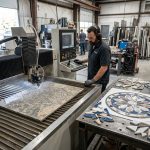
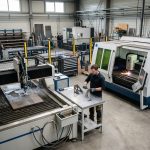
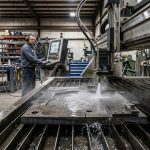
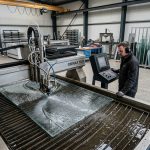


Hydro-Lazer, Inc. provides glass cutting services that produce glass to precise shapes, sizes, and lengths while preserving the structural integrity of the workpiece. Waterjet technology delivers clean, burr-free edges on the first pass, with zero secondary grinding and zero material loss. For architectural glass panels, decorative glasswork, and precision applications from ultra-thin panels to multi-layer military vehicle glass, waterjet is the method the material demands.
Why Glass Demands a Precision Cutting Method
Glass is a uniquely sensitive material that requires a controlled cutting approach to stay intact. Uncontrolled pressure causes micro-fractures, edge chipping, or outright workpiece breakage every time. Hydro-Lazer, Inc., located at 134 Armstrong Drive in Freeport, Pennsylvania, uses waterjet technology because it works with glass’s material properties to produce accurate, clean cuts on complex geometries.
Waterjet Glass Cutting Services Produce Smooth, Burr-Free Edges That Require Zero Secondary Tooling
Diamond saw cutting uses a rotating blade under mechanical contact with the glass surface. The cutting wheel generates microfractures along the cut edge, which become failure points under installation loads, thermal cycling, or vibration. Secondary processing, like edge grinding or polishing, is the standard response, adding time, cost, and handling risk to every piece.
Waterjet glass cutting services produce smooth cuts and eliminate the need for any extra tooling. The cut edge requires no grinding, polishing, or secondary finishing, as the waterjet process produces precise cuts free of burrs and preserves the form and structure of the workpiece. For architectural glass joints and decorative glass alike, waterjet delivers both structural integrity and aesthetic precision.
Minimal Material Wastage From First Cut to Last
The True Cost of Conventional Glass Cutting Waste
Every broken glass workpiece represents two losses: the material value of the piece and the production time spent on a part that cannot be used. For architectural glass panes and large-format sheet stock, a single breakage event becomes a direct financial loss requiring replacement material and schedule recovery. Plasma and mechanical cutting methods apply heat and pressure, leading to material damage and producing exactly this outcome.
How Waterjet Protects Glass Stock
Hydro-Lazer’s waterjet glass cutting services ensure minimal material waste while preserving the form and structure of the workpiece. The process handles mirrors, glass ornaments, and showpieces with precision and produces zero cracks, meaning zero replacement stock and zero scrap disposal. The waterjet stream eliminates consumable blade wear entirely, eliminating the tooling replacement costs that accumulate in high-volume glass cutting programs.
Waterjet glass cutting services are gaining popularity worldwide because they can produce contours and intricate shapes from glass panes and sheets that traditional methods struggle to achieve. Complex geometries can be achieved on the first cut, with zero breakage and zero waste. That first-cut accuracy is what makes waterjet the preferred choice for fabricators managing high-value glass cutting programs.
Safer Operations Through Waterjet Glass Cutting
Glass Dust and Fragment Hazards in Conventional Fabrication
Diamond saw cutting and mechanical glass cutting generate glass dust and fragment debris at the cut station. Glass dust is a documented occupational health hazard that requires respiratory and eye protection in any fabrication environment where it is produced. Fragment cleanup from cracked workpieces adds facility overhead and creates secondary sharp-edge hazards during material handling.
How Waterjet Creates a Cleaner, Safer Cutting Environment
Hydro-Lazer’s waterjet process produces zero cracked workpieces, which means zero glass fragment debris and zero fragmentation cleanup at the cutting station. Zero material damage is associated with the waterjet cutting technique, and minimal material wastage means zero shattered pieces to manage or dispose of. Glass materials at Hydro-Lazer are handled with extreme caution throughout the cutting process, reflecting the controlled, contact-free nature of waterjet fabrication.
Glass Applications Served by Hydro-Lazer’s Waterjet Cutting Services
Hydro-Lazer’s glass cutting services cover the full range of architectural and decorative glass applications:
- Ultra-thin glass panels — precision cutting on delicate stock with zero cracking or edge damage, where mechanical contact methods would introduce immediate fracture risk.
- Multi-layer glass for military vehicles — waterjet handles structural glass assemblies requiring clean, precise cuts through bonded or laminated glass layers.
- Mirrors — highly accurate cutting that produces clean edges free of chipping or burring on reflective glass stock.
- Glass ornaments — precision decorative glass cutting, free of cracking or surface damage, preserving finished workpiece quality.
- Showpieces — precision cutting for display and artistic glass where edge quality and geometric accuracy define the finished product.
- Glass panes and sheet — architectural-scale glass panel cutting for building applications, where large-format stock demands a zero-breakage process.
- Contours and intricate shapes — complex geometries achievable on the first cut, free of breakage or secondary processing.
All glass workpieces are cut to desired shapes, sizes, and lengths, with no geometric or dimensional constraints specified for Hydro-Lazer’s waterjet glass cutting program.
Why Architectural and Decorative Glass Projects Are Where Waterjet’s Advantages Are Most Critical
Architectural and decorative glass projects both demand edge quality and dimensional precision that waterjet reliably delivers on complex shapes. For architectural glass, complex contour cuts on large-format, high-value stock require first-cut accuracy, since smooth edges are critical for structural glazing joints, where edge condition affects long-term installation performance. Waterjet produces those edges consistently, with zero secondary grinding and zero dimensional alteration.
For decorative glass mirrors, ornaments, and showpieces, a burr, chip, or microfracture at the cut line is a finished-product defect. Waterjet’s burr-free, smooth-cut output consistently delivers the edge quality decorative glass applications require on complex shapes. Both categories benefit from the zero-crack assurance that waterjet’s heat-free, contact-free process provides on every cut.
Request a Glass Cutting Services Quote From Hydro-Lazer in Freeport, Pennsylvania
Hydro-Lazer, Inc. 134 Armstrong Drive, Freeport, PA 16229 Phone: 724-295-9100 Email: john@hydro-lazer.com Request a quote: hydro-lazer.com/rfq/
Hydro-Lazer provides glass cutting services for architectural glass panes and sheets, decorative glass, mirrors, ornaments, showpieces, ultra-thin panels, and multi-layer military-vehicle glass. All glass is cut to precise shapes, sizes, and lengths, burr-free, smooth, and free of cracking and material damage. Contact Hydro-Lazer to discuss your glass cutting program and request a project quote.
Frequently Asked Questions
What is waterjet glass cutting, and how does it work?
Waterjet glass cutting uses a high-pressure stream of water mixed with abrasive particles to cut glass without mechanical contact or heat. The cutting stream applies zero pressure concentrations and zero thermal input, which are the two primary causes of glass cracking. The process produces smooth, burr-free edges while preserving the workpiece’s full structural integrity.
Why is waterjet the preferred method for glass compared to diamond saw cutting?
Diamond saw cutting generates micro-fractures along the cut edge that require secondary grinding or polishing to remove. Waterjet cutting produces smooth, burr-free edges, free of any secondary tooling, with zero additional handling and zero edge damage that creates stress concentration points in the finished piece. The waterjet process also eliminates consumable blade wear, removing that ongoing cost from the cutting program.
Does waterjet cutting preserve the integrity of the glass workpiece?
Waterjet glass cutting produces zero cracks and zero material damage to the workpiece. The process applies zero heat and zero mechanical contact force, delivering accurate, clean cuts on every workpiece. Glass materials are handled with extreme caution throughout the cutting operation to preserve workpiece quality from setup through delivery.
What types of glass can be cut with a waterjet?
Hydro-Lazer’s glass cutting services handle ultra-thin glass panels, multi-layer glass for military vehicles, mirrors, glass ornaments, showpieces, architectural glass panes and sheets, and complex contour and intricate shape geometries. All glass types are cut to desired shapes, sizes, and lengths. Zero cracking and zero material damage are the consistent outputs across the full application range.
Is waterjet glass cutting safer than conventional methods?
Conventional glass cutting methods, including diamond-saw cutting, generate glass dust and glass fragments, which are documented occupational health hazards. Waterjet glass cutting produces no cracked workpieces, no glass fragments, and no glass dust at the cutting station. The waterjet process eliminates the primary fragmentation hazards associated with conventional glass fabrication.
Does waterjet glass cutting require edge finishing after cutting?
Waterjet glass cutting produces smooth cuts that eliminate the need for extra tooling. The cut edge requires zero secondary grinding, polishing, or edge finishing. Waterjet delivers finished edge quality directly off the cutting table, with zero additional production steps required.
How does waterjet glass cutting reduce material waste?
Waterjet glass cutting minimizes material waste because it delivers zero cracks and zero workpiece breakage. Clean cuts are achieved on the first pass, with no broken pieces, no replacement stock required, and no scrap from failed cuts. That first-cut accuracy protects material investment across every project.
Can a waterjet cut intricate shapes and contours in glass?
Yes. Waterjet glass cutting can achieve contours and intricate shapes in glass panes and sheets that traditional cutting methods struggle to produce. Complex geometries are achieved on the first cut, without breakage. This first-cut capability is a documented advantage of waterjet over diamond saw and plasma cutting for glass fabrication.
Where is Hydro-Lazer’s glass cutting facility located?
Hydro-Lazer, Inc. is located at 134 Armstrong Drive, Freeport, PA 16229. The company provides waterjet glass cutting services for architectural, decorative, military, and precision glass applications. Contact Hydro-Lazer at 724-295-9100 or john@hydro-lazer.com, or submit a project inquiry at hydro-lazer.com/rfq/.
What makes waterjet the right choice for architectural glass projects?
Architectural glass projects require complex contour cuts on large-format, high-value stock where first-cut accuracy protects significant material investment. Waterjet delivers smooth, burr-free edges on complex geometries, without cracking or secondary grinding. Those output characteristics match the precision and material-protection requirements of architectural glass fabrication on every project.