
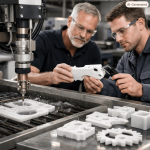
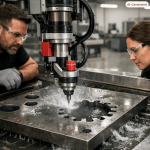
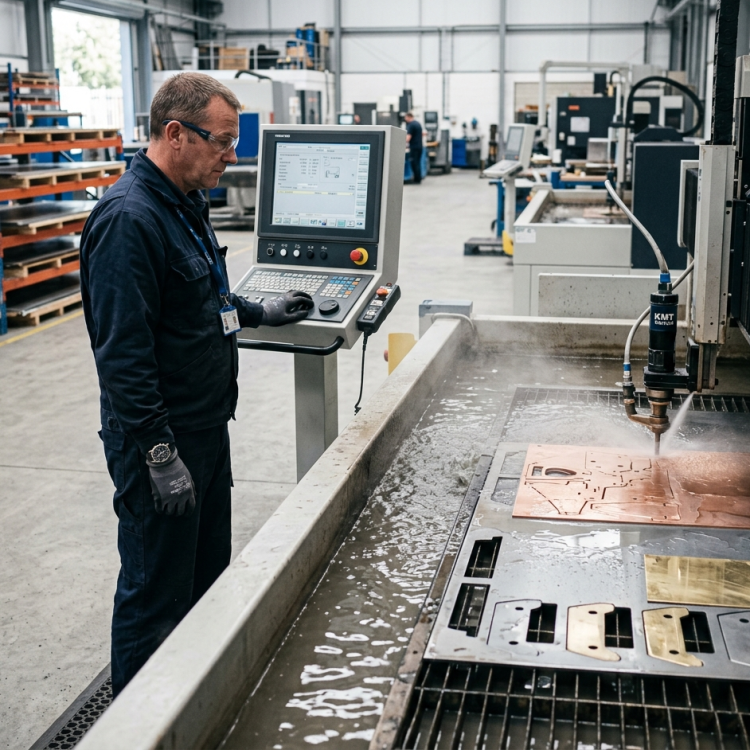

When a fabrication program calls for a challenging grade like hardened tool steel, titanium, copper, or brass, the real question is whether the cutting method can handle that specific grade without damaging it. Hydro-Lazer, Inc. provides metal cutting services from Freeport, Pennsylvania, using abrasive waterjet technology. The process cuts carbon steel, stainless steel, hardened tool steel, aluminum, titanium, copper, and brass with clean edges, no burrs, and no burn marks.
Can Waterjet Cut Hardened Tool Steel?
Hardened tool steel is one of the most challenging grades in precision metal fabrication. Its extreme hardness makes it valuable for tooling applications, but it also makes it difficult to cut cleanly with conventional methods.
- Compatibility: Hardened tool steel is a fully documented compatible material for Hydro-Lazer’s metal cutting services.
- What Happens with Conventional Methods? EDM is slow and limited in geometry. Plasma and laser cutting introduce heat that can crack hardened steel or alter its temper at the cut edge. That thermal stress alters the material’s metallurgical state, compromising the hardness properties for which the grade was specified.
- How does a waterjet work on This Grade? Abrasive waterjet cuts through hardened tool steel at high velocity with no heat generated. The temper and hardness of the material are fully preserved from the first cut to the last. No work hardening occurs, and the metal grain structure stays unchanged throughout the cutting process.
- The Output: Components come out dimensionally accurate, with their metallurgical properties fully intact, and with clean cuts, no burrs, burn marks, or cracks, ready for tooling, dies, and precision mechanical assemblies.
Does Waterjet Work on Titanium?
Titanium is the material of choice for applications where strength-to-weight ratio and corrosion resistance are non-negotiable. It is also the grade most vulnerable to thermal cutting damage.
- Compatibility: Titanium is fully documented as a compatible material for Hydro-Lazer’s metal-cutting services.
- What Happens with Conventional Methods? Titanium is highly reactive at elevated temperatures. Heat from laser or plasma cutting causes oxidation and surface contamination at the cut edge. In aerospace and power-generation components, oxidation compromises corrosion resistance and structural integrity at cut edges.
- How does a waterjet work on This Grade? Abrasive waterjet cutting is a cold process. No heat is generated at any point during the cut. Thermal reactivity is a non-factor in this process. No heat-affected zones form, no oxidation occurs, and no surface contamination is introduced.
- The Output: Clean, burr-free cuts on titanium with no burn marks, no cracks, and no change in grain structure. Corrosion resistance and structural integrity remain exactly as specified, which is essential for aerospace structural components, mining equipment, and power generation assemblies.
Can Waterjet Cut Copper Without Heat Distortion?
Copper presents a distinct cutting challenge. Its high thermal and electrical conductivity means heat introduced during cutting distributes rapidly through the material, creating heat-affected zones across a wider area.
- Compatibility: Copper is fully documented as a compatible material for Hydro-Lazer’s metal-cutting services.
- What Happens with Conventional Methods? Plasma and laser cutting introduce heat that conducts rapidly through copper’s structure. Wider heat-affected zone margins, discoloration, and potential dimensional distortion spread across the part. EDM is slow and geometrically limited on complex copper components.
- How does a waterjet work on This Grade? No heat is generated during waterjet cutting. Copper’s conductivity is irrelevant to a cold cutting process. The abrasive water stream cleanly cuts through copper, regardless of its thermal properties.
- The Output: Clean cuts with no burn marks, no burrs, and no distortion. Copper components arrive with consistent edge geometry and no heat-induced dimensional variation, suitable for electrical assemblies, power generation components, and precision industrial fabrication.
Does Waterjet Handle Brass for Decorative and Precision Applications?
Brass is specified across decorative fabrication, mechanical components, and precision industrial parts. It is fully documented and compatible with waterjet cutting at Hydro-Lazer.
- Compatibility: Brass is fully documented as a compatible material for Hydro-Lazer’s metal-cutting services.
- What Happens with Conventional Methods? Brass’s zinc content makes it susceptible to stress-corrosion cracking under mechanical cutting forces. Thermal cutting can alter the alloy composition at the cut edge. Both affect surface finish quality in decorative applications and dimensional accuracy in precision parts.
- How does a waterjet work on This Grade? No mechanical contact force or heat is applied. Brass is cut with the abrasive water stream without introducing stress or thermal alteration to the alloy. The zinc content stays undisturbed, and the edge comes out clean.
- The Output: Burr-free cuts with clean edges, suitable for decorative sign fabrication, architectural elements, precision mechanical components, and industrial brass assemblies.
What Makes Waterjet the Right Choice for These Metal Grades?
Hardened tool steel, titanium, copper, and brass each present different cutting challenges. Waterjet eliminates all those failure modes through a single underlying mechanism.
No Heat Generated
This single property eliminates heat-affected zones across all four grades, thermal distortion in copper, oxidation in titanium, temper alteration in hardened tool steel, and alloy composition changes in brass.
No Direct Mechanical Contact
The waterjet stream exerts no contact force, as with a blade or grinding wheel. Work hardening, stress corrosion cracking in brass, and mechanical surface damage are all eliminated.
Additional Process Advantages
Waterjet metal cutting services are 5 to 10 times faster. The process cuts thicker metals that are otherwise difficult to cut with plasma. Minimal material wastage makes it economically viable for both prototype quantities and large contract runs. Clean cuts with no burrs, burn marks, or cracks are consistent across all documented metal grades.
What Industries and Applications Does Hydro-Lazer Serve?
Hydro-Lazer’s abrasive waterjet metal-cutting services serve industries where demanding metal grades and precise fabrication requirements converge.
Aerospace
Titanium and hardened steel components require fully preserved metallurgical properties with no heat-affected zones, no oxidation, and no temper alteration.
Mining
Metal parts are cut to specified dimensions for equipment fabrication, including grades that resist conventional cutting methods.
Power Generation
Copper and steel components for electrical and mechanical assemblies, where both dimensional accuracy and material integrity are required.
Agriculture
Metal parts in specified dimensions for equipment manufacturing across carbon steel, stainless, and aluminum grades.
Manufacturing
Electronic enclosures, brackets, chassis, custom panels, tubular frames, and electro-mechanical assemblies are all documented application types.
OEMs and fabrication centers sourcing a single vendor for multi-metal component programs establish documented client relationships with Hydro-Lazer. Qualifying a single waterjet provider across titanium, hardened tool steel, and copper significantly reduces sourcing complexity.
Can Waterjet Support Both Prototype Orders and Large Contract Runs?
One practical question procurement managers ask when evaluating a metal-cutting services vendor is whether the vendor can support the full production lifecycle, from first-article prototypes to large yearly contract runs.
Hydro-Lazer supports production for any quantity. Accepted design inputs include hand sketches and CAD drawings. Offline programming and CAD digitizing software are used to render cut paths from submitted designs. Minimal material wastage supports both prototype economics and high-volume contract viability.
Hydro-Lazer has operated since 1985 and has a proven track record of completing more than 10,000 jobs across grades, tolerances, and volumes.
How to Request a Metal Cutting Quote
Submitting an inquiry to Hydro-Lazer requires only a material specification and a design input. The process is straightforward for any metal grade, complexity, or production volume.
Requests are submitted via the RFQ page at hydro-lazer.com/rfq/ or by contacting Hydro-Lazer directly. Accepted inputs are hand sketches or CAD drawings with no special format required. Any documented metal grade, any quantity, and any application are accommodated. Competitive pricing is documented for production contract viability.
Frequently Asked Questions
Can waterjet cutting handle hardened tool steel without cracking or altering the temper?
Abrasive waterjet cutting hardened tool steel generates no heat, so the temper is fully preserved throughout the cut. No cracking, no grain structure change, and no hardness alteration occur. The workpiece exits the cutting program with its specified metallurgical properties intact.
Why is waterjet preferred over laser or plasma for cutting titanium?
Titanium is highly reactive at elevated temperatures, and laser and plasma cutting introduce enough heat to cause oxidation and surface contamination at the cut edge. Waterjet is a cold process that generates no heat, eliminating oxidation and heat-affected zones. Titanium’s material properties are fully preserved.
Does waterjet cutting affect copper’s electrical conductivity?
Waterjet cutting generates no heat, so copper’s thermal and electrical properties are unaffected by the cutting process. The cold, abrasive stream cuts copper cleanly without introducing heat-affected zones or dimensional distortion, as plasma and laser processes do in high-conductivity metals.
Can a waterjet cut brass without stress corrosion cracking?
Brass is susceptible to stress-corrosion cracking under mechanical cutting forces, whereas waterjet does not make direct mechanical contact with the workpiece surface. Combined with the absence of heat, the waterjet produces clean, burr-free brass cuts without altering the alloy composition or introducing stress into the material.
How does waterjet compare to EDM for cutting titanium or hardened steel?
Waterjet cutting is 5 to 10 times faster and is not geometrically limited like EDM is on complex parts. EDM is also slow on thicker stock, whereas waterjet can handle thicker metals that are otherwise difficult to process with conventional methods.
What metal grades does Hydro-Lazer support?
Documented compatible metals include carbon steel, stainless steel, hardened tool steel, aluminum, titanium, copper, and brass. The abrasive waterjet process is compatible across all of these grades with no grade-specific tooling changes required.
Does waterjet metal cutting produce burrs, or does it require post-cut finishing?
Hydro-Lazer’s abrasive waterjet process produces clean cuts with no burrs, burn marks, or cracks across all documented metal grades. Components typically arrive ready for use or for assembly, with no secondary deburring or edge-finishing operations required.
Can Hydro-Lazer handle both prototype quantities and large production contract runs?
Hydro-Lazer supports production for any quantity, from single first-article prototypes through large yearly contract runs. Minimal material wastage makes the process economically viable at both scales.
What file formats does Hydro-Lazer accept for metal cutting programs?
Hydro-Lazer accepts hand sketches and CAD drawings with no special format required to begin a cutting program. Offline programming and CAD digitizing software are used to develop cut paths from submitted design inputs.
Where is Hydro-Lazer located, and how can a quote be requested?
Hydro-Lazer, Inc. is located at 134 Armstrong Drive, Freeport, PA 16229. RFQ submissions are accepted at hydro-lazer.com/rfq/. Direct contact is available at 724-295-9100 or john@hydro-lazer.com.