

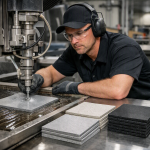
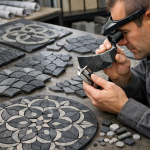

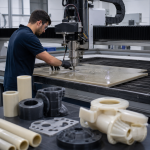
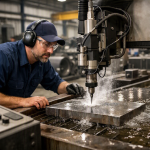
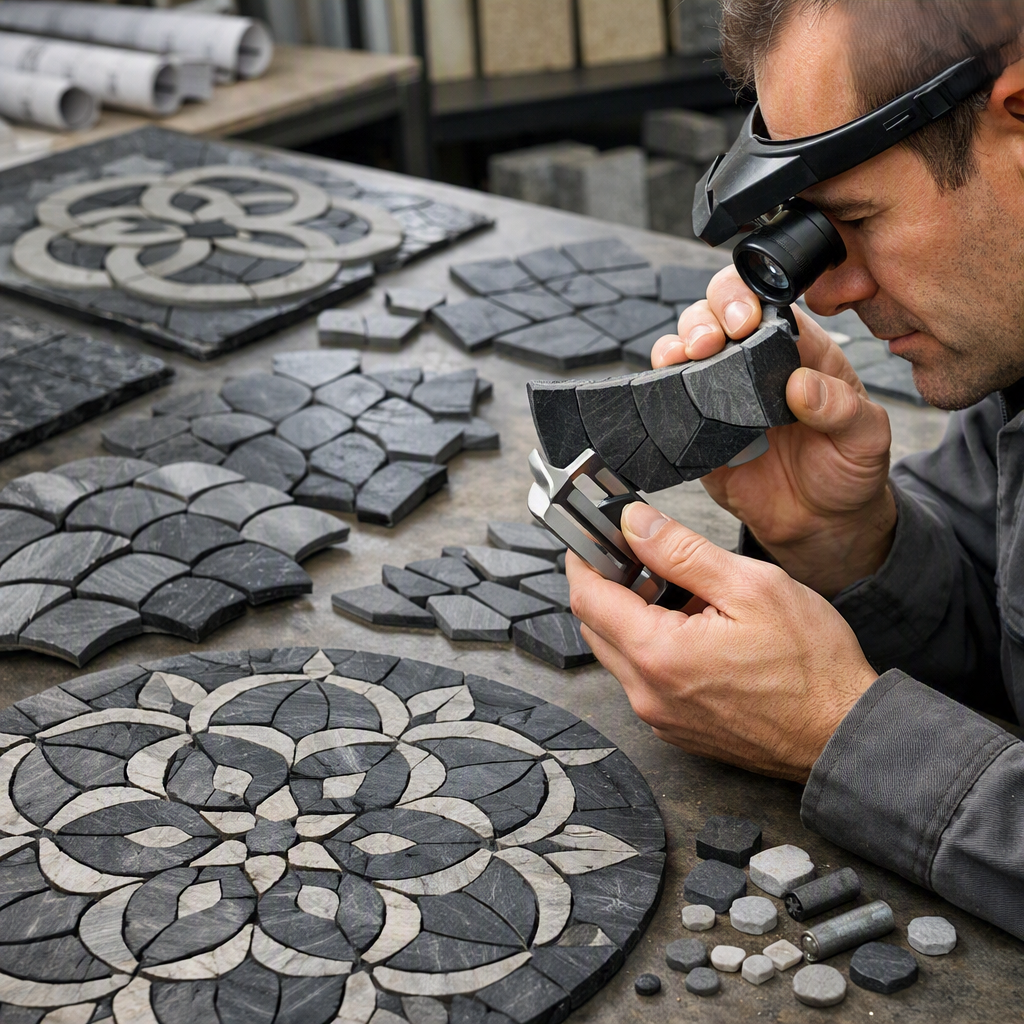

Slate tile waterjet cutting gives artisan flooring professionals and home builders a way to cut mosaics, organic motifs, and curved geometric patterns into natural slate. A guided, multi-axis abrasive waterjet moves the cutting stream along any programmed path, including continuous curves and interlocking mosaic shapes. Water pressure between 40,000 and 60,000 PSI keeps every edge clean and protects the stone’s natural layers. This process makes possible every design that starts as a curve or freeform shape.
Slate Tile Waterjet Cutting For Mosaic Designs
Mosaic work calls for slate pieces cut to exact, often irregular shapes that fit together into one composition. Slate tile waterjet cutting shapes every piece with a clean edge, so the pieces set together with tight, chip-free seams. The multi-axis machine follows any programmed outline, which keeps each mosaic piece consistent with the design. Slate pairs well with ceramic or porcelain in the same composition, giving designers more materials to combine in one floor.
Mosaic medallions use the same cutting method for circular and radial patterns. Each piece keeps its natural color and texture through the cut, which supports the finished look of the composition. Flooring teams set the pieces with confidence, since the edges arrive ready for placement.
Organic Motifs In Natural Slate
Leaf shapes, vine patterns, and water motifs move through continuous curves that change direction many times through one design. A multi-axis machine tracks every curve in one motion, holding the design’s detail from start to finish. Slate tile waterjet cutting adjusts water pressure to the tile thickness and the path shape, so fine detail holds through the full cut. Designers send a hand sketch or a CAD file, and the concept becomes a cutting program in-house.
Curved Geometric Patterns In Slate Flooring
Curved geometric patterns sit between straight-edged geometry and fully organic shapes, with arcs, rounded corners, and repeating curved elements. Large slate slabs allow a curved geometric program to span a full floor with one continuous piece of stone. Cutting tolerance stays within .003 inches on select materials, keeping every curve consistent across the full pattern. Slate tile waterjet cutting also uses color changes between slate pieces, turning contrast into part of the design.
Natural Slate Character In Freeform Designs
Slate carries a rough, natural surface that gives texture to any freeform pattern cut into it. Every tile holds its own natural variation, so a mosaic or organic design gains character from the stone itself. Gold, white, black, red, green, and gray slate open a full range of color for any freeform composition. Slate also holds up well over years of daily use, which supports a floor built to last.
Flooring teams choose slate tile waterjet cutting for this reason, since the process protects the natural texture through the pattern. The natural color range supports smooth transitions across a freeform design. Every finished floor keeps the organic feel that drew the design team to slate in the first place.
From Sketch To Finished Slate Floor
A finished design file works well, as does a simple hand sketch or rough concept drawing. The concept becomes a precise in-house cutting program, ready for the waterjet process. Large slab cutting supports one artisan piece or a full floor program under the same workflow. Slate tile waterjet cutting scales to any project size, whether it covers one entryway or a complete floor throughout a home.
Slate Tile Waterjet Cutting Services In Freeport, Pennsylvania
Hydro Lazer provides slate tile waterjet cutting for mosaics, organic motifs, and curved geometric designs, using multi-axis machines set between 40,000 and 60,000 PSI. Slate comes in gold, white, black, red, green, and gray, ready for any freeform composition. Send a sketch, a CAD file, or a concept through the request form for a quote.
Hydro Lazer, Inc. | 134 Armstrong Drive, Freeport, PA 16229 Phone: 724 295 9100 | Email: john@hydro-lazer.com Request a Quote: hydro-lazer.com/rfq/
Frequently Asked Questions
Can waterjet cutting shape slate into mosaic pieces?
Yes, a multi-axis abrasive waterjet cuts slate into any shape a mosaic composition calls for. Each piece gets a clean edge, ready to set beside the next. This process supports slate tile waterjet cutting for mosaic flooring, with consistent, chip-free edges throughout.
What PSI range works for slate cutting?
Slate receives a cut between 40,000 and 60,000 PSI, a standard range for this process. Pressure is set to match the tile thickness and the design path. Adjusting the pressure protects the stone’s natural texture through the full cut.
Can a hand sketch start a slate cutting project?
A hand sketch or a rough concept drawing works well to start a project. The sketch turns into a precise cutting program in-house, ready for the waterjet process. Full CAD files also work well for designers who already have one ready.
Can slate combine with other tile materials in a mosaic?
Yes, slate pairs well with ceramic or porcelain within the same mosaic composition. This combination gives designers more material options within a single floor design. The finished composition keeps a naturalized look while it blends materials together.
Does the waterjet process affect the natural grain of slate?
The waterjet process relies on pressurized water alone, keeping the cut free of blade contact and heat. This protects the natural cleavage planes of the stone, so each piece stays whole through the cut. The finished piece keeps its natural texture and color throughout the process.
What is the difference between organic motifs and curved geometric designs?
Organic motifs use freeform shapes such as leaves, vines, or water patterns, with curves that flow continuously through the design. Curved geometric designs sit between organic freeform shapes and straight-edged geometry, using arcs, rounded corners, and repeating curved elements. Both design types rely on a multi-axis machine to hold detail through every curve.
How precise is this cutting process?
Cutting tolerance stays within .003 inches on select materials, which keeps every curve and shape consistent across a full pattern. This precision supports repeating elements within a curved geometric or mosaic design. Consistent tolerance also keeps large floor programs aligned across many individual pieces.
Can a curved pattern span a full floor without visible seams?
Large slate slabs allow a curved or mosaic pattern to span a full floor with continuous stone. This approach keeps the design whole, with color and texture flowing across the entire space. Full floor programs use the same cutting process as a single artisan piece, at a larger scale.
What colors of slate work with freeform cutting?
Slate comes in gold, white, black, red, green, and gray, giving designers a full range of colors for a freeform composition. These colors combine well within one design, adding contrast or a smooth transition across the pattern. Color choice also supports the natural variation that each slate tile already carries.